
Hard Water and Tankless Descaling Requirements
TX, AZ, IN, NV, UT have widespread hard water that destroys unflushed tankless units. Scale-inhibitor and softener options, signs, and cost consequences.
7 min read
We often find that residents in Phoenix, Las Vegas, San Antonio, Salt Lake City, or central Indiana do not realize their water is among the hardest in the US. A 2025 water quality report confirmed that areas like Indianapolis reach a staggering 20 grains per gallon.
Our team sees this extreme mineral content completely change how often a hard water tankless water heater requires descaling. Ignoring this maintenance leads to strict consequences.
We laid out the exact steps to protect your system below.
What Hard Water Does to a Tankless
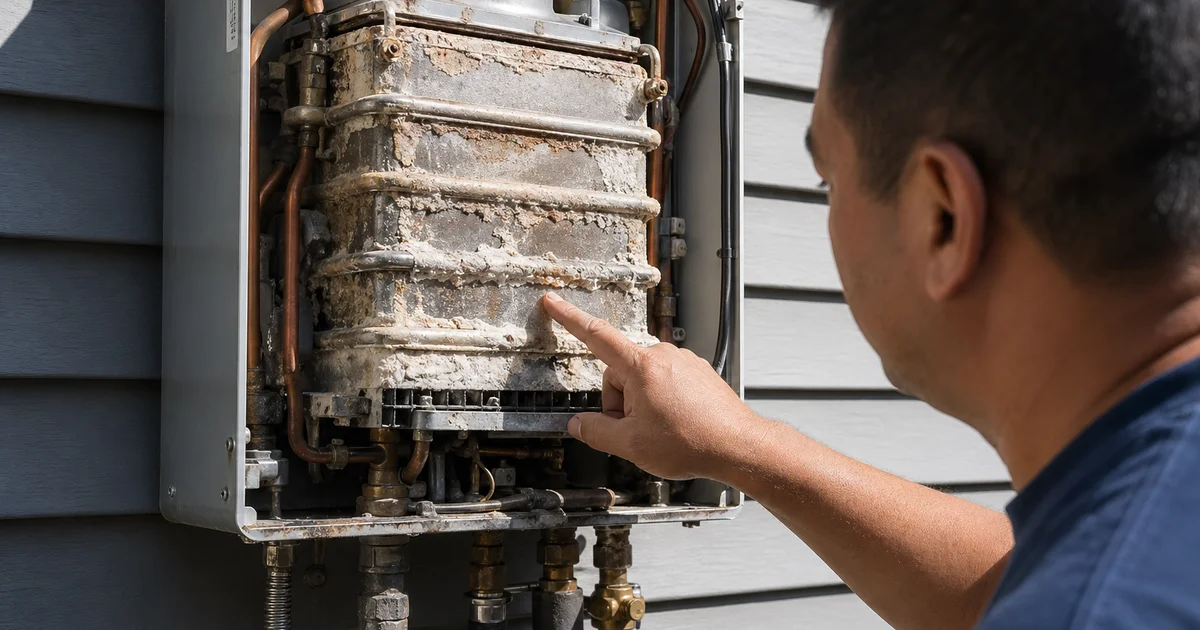
Hard water creates a thick calcium layer inside your unit, which destroys efficiency and eventually cracks the heat exchanger. We know that calcium and magnesium dissolved in your water precipitate out as scale when heated.
This mineral buildup deposits directly on the internal metal surfaces. Our technicians see the damage escalate predictably over time.
- Scale layer thickens: In regions without descaling, you will see 1 to 2 millimeters of growth per year.
- Heat transfer efficiency drops: The U.S. Department of Energy notes that a unit can be up to 34% more efficient than a standard tank, but scale wipes out these savings.
- Flow restriction increases: Water passes through narrower channels, causing noticeable pressure loss.
- Heat exchanger metal stresses: Uneven heating causes severe thermal cycling damage.
- Eventually, the exchanger cracks: Unmaintained installs typically fail around year 8 to 10.
We regularly see the 20-year design life of a tankless drop to just 8 to 12 years when regular flushing is skipped. Hard water tankless damage is entirely preventable with a simple routine.
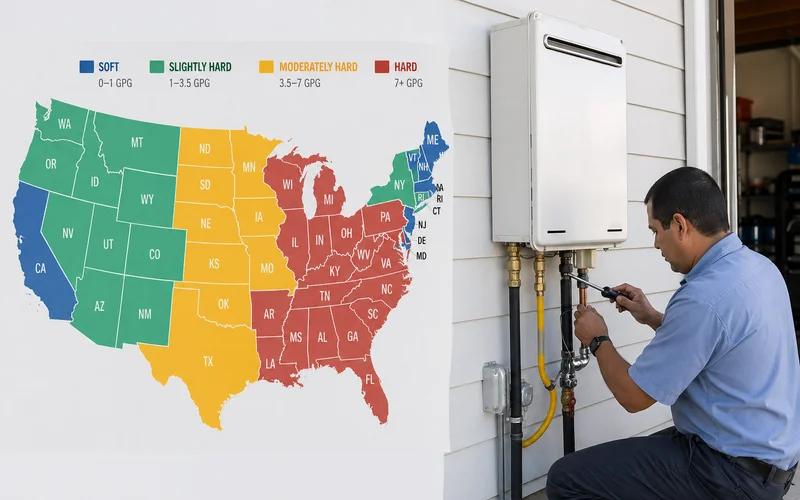
US Hard Water Severity Map
Over 85% of US homes have hard water, but specific regions experience extreme severity according to recent water quality studies. We rely on data from the U.S. Geological Survey to classify hardness levels across the 15 states we serve.
Anything above 10.5 grains per gallon is considered very hard.
Extreme Hardness (15+ grains/gallon)
- Phoenix metro, Tucson (AZ)
- Las Vegas valley, Reno (NV)
- Salt Lake Valley, Utah Valley (UT)
- San Antonio, Hill Country (TX)
High Hardness (10-15 grains/gallon)
- Dallas/Fort Worth, Austin (TX)
- Indianapolis, central Indiana counties (IN)
- Central Florida (FL)
- Eastern North Carolina (NC)
Moderate Hardness (7-10 grains/gallon)
- Most of Colorado Front Range (CO)
- Parts of Northern California (CA)
- Boston metro (MA)
Soft (under 7 grains/gallon)
- Most of Massachusetts, New York
- Most of Pennsylvania, Virginia, Maryland
- Coastal Florida, North Carolina
- Coastal California (varies)
Our top recommendation is checking your local water utility’s annual report for ZIP-specific hardness. A cheap $10 test strip from a hardware store gives you a fast baseline.
Two Mitigation Strategies
The right method to fight scale depends entirely on your budget and discipline. We recommend specific approaches based on your local water testing results.
Strategy 1: Aggressive Descaling Schedule
Regular manual flushing is the cheapest way to clear minerals, but it requires a strict routine in hard water areas. Our teams use food-grade acetic acid or commercial solutions like Flow-Aide to circulate through the unit.
Without a water softener, extreme hard-water regions need a 6-month flushing minimum. We find this aggressive approach is the cheapest path but demands discipline.
Two flushes per year run about $150 to $250 each, totaling $300 to $500 annually in maintenance.
Strategy 2: Whole-House Water Softener
A salt-based whole-house water softener strips out calcium before it ever reaches the heater. We consider this the gold standard for protecting your plumbing investment.
A properly sized softener removes over 90% of dissolved calcium and magnesium. Our clients with a softener installed gain significant leeway.
- Hard regions: extend to annual flushing.
- Very hard regions: extend to semi-annual flushing.
A standard installation runs $1,200 to $3,500, plus an ongoing $200 to $400 a year for salt and maintenance. We know the math strongly favors a softener for homes staying 8 or more years in extreme hardness regions.
- Softener reduces flushing cost by roughly $250 a year.
- Softener extends tankless life, offering $500 a year prorated against early replacement.
- Softener also protects dishwashers, washing machines, and water-using appliances.
Total payback typically hits in 4 to 6 years.
Strategy 3: Scale Inhibitor (Limited Use)
Scale inhibitors change the chemical structure of minerals so they cannot stick to metal surfaces. We often install systems like the Navien PeakFlow or American Water Heaters X3 for customers who cannot fit a full softener.
These compact cartridges sit at the cold inlet and convert calcium carbonate into a softer form. Our data shows they are less effective than a full salt-based softener but significantly cheaper.
You can expect a $200 to $400 install cost, plus a $50 to $100 annual cartridge replacement. We highly recommend this compact setup for renters and smaller homes.
Signs of Scale Buildup
Catching scale early prevents massive repair bills and complete system failure. We always tell clients to watch for subtle changes in performance before a total shutdown occurs.
Calcium buildup tankless problems rarely happen overnight.
- Audible popping or knocking during operation, which means mineral deposits are flexing.
- Reduced flow at hot taps over time.
- Longer warm-up time before hot water arrives.
- Visible scale at fittings outside the unit, which means it is much worse inside.
Our technicians usually fix the unit for $150 to $250 if you catch these early indicators. Waiting until the heat exchanger cracks turns a simple maintenance call into an $800 to $1,500 nightmare.
Repair Cost Reality
Skipping maintenance guarantees a catastrophic system failure and severe financial consequences. We compiled 2026 industry data showing the national average to replace a heat exchanger is $1,750.
The cost cascade in hard-water states is unforgiving.
| Years Without Descaling | Likely Outcome | Cost |
|---|---|---|
| 0 to 1 (annual) | Healthy unit | $150 to $250 per year |
| 2 to 3 (skipped) | Performance degradation | $300 to $500 catch-up flush |
| 4 to 5 (extended skip) | Heat exchanger damage starting | $1,200 to $1,800 repair, partial |
| 6+ (long skip) | Heat exchanger replacement or unit replacement | $1,500 to $5,000+ |
We want to make it clear that the descaling cadence is simply not optional in a hard-water region.
State-Specific Resources
Distinct service patterns across different regions keep your system running efficiently. Our records clearly show how local geology dictates your exact maintenance needs.
- Arizona: extreme hardness requires a semi-annual cadence.
- Texas: varies by region but is semi-annual in most metros.
- Nevada: extreme hardness across the entire Las Vegas valley.
- Utah: extreme hardness in the Salt Lake and Provo areas.
- Indiana: semi-annual scheduling is necessary in central counties.
We make scheduling easy and stress-free. For booking descaling on the right schedule, our maintenance service auto-schedules by ZIP and water hardness.
We know that handling hard water tankless water heater descaling feels like a chore. The alternative is paying thousands for an entirely new system.
Our team suggests grabbing a test strip today to figure out your exact water hardness level. You can then easily book a service or order a descaling kit to keep your hot water flowing freely.
Frequently Asked Questions
Does a water softener completely solve scaling?
What's the cost of ignoring hard-water descaling?
Can scale damage be reversed once it's there?
Related Guides
DIY Tankless Flushing Risks vs Professional Service
DIY flushes commonly miss flow direction, cabinet cleaning, filter replacement, or unit reset — often leaving scale behind. When DIY pays vs when it costs more.
How Often Should I Service My Tankless Water Heater?
Annual baseline, every 6 months in hard-water states. Why skipping service voids warranty and shortens lifespan from 20+ years to tank-equivalent.
Signs Your Tankless Water Heater Needs Maintenance Now
Reduced flow, longer warm-up, error codes, audible scaling, lukewarm output — each tied to root cause. When to book service before damage cascades.
Annual Tankless Water Heater Maintenance Checklist
Step-by-step what a proper annual tankless service covers: descale, filter, vent, combustion, leak check, performance test. What cheap providers skip.