
How Often to Flush a Tankless Water Heater
Annual baseline, every 6 months for hard water (>10 grains/gallon). How softeners change the cadence and what skipping costs you in warranty.
5 min read
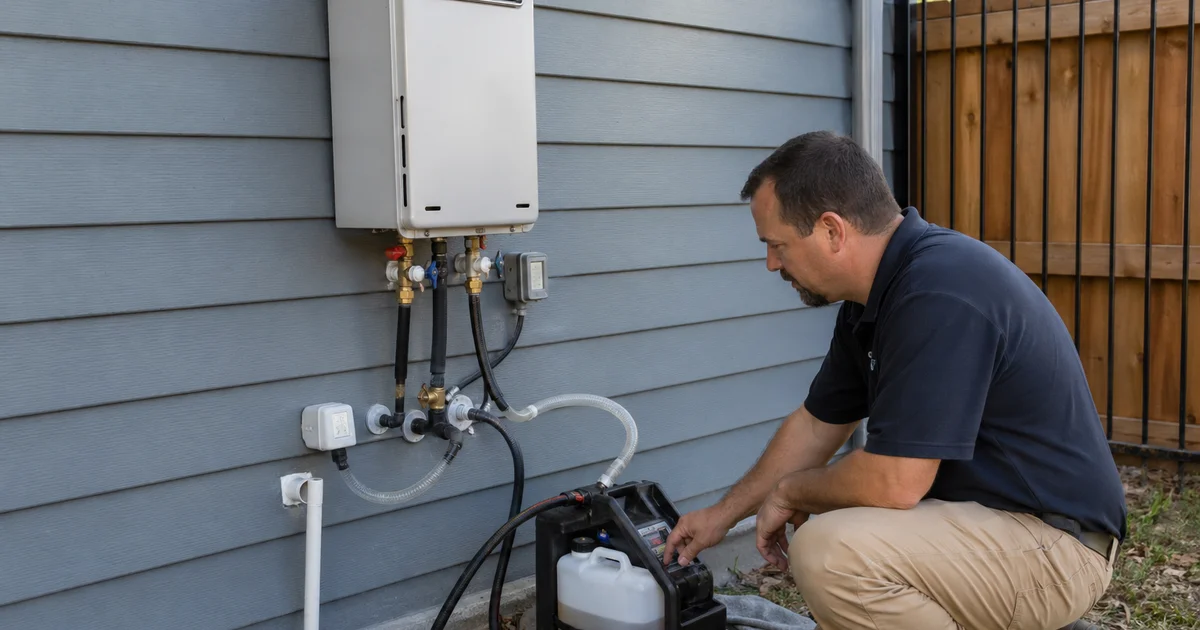
We see this scenario constantly in the field. A homeowner installs a premium tankless unit, expecting decades of flawless hot water.
Mineral buildup quickly ruins those plans.
Our technicians know that standard annual maintenance includes a routine flush, but many regions require a separate, dedicated descaling visit. Just 1.5 millimeters of calcium scale can reduce your heat transfer efficiency by a massive 12 percent.
We are going to break down exactly how often to flush a tankless water heater based on your local water demands. Let’s look at the hard data, the impact of water softeners, and the true cost of ignoring this simple task.
The Cadence Table
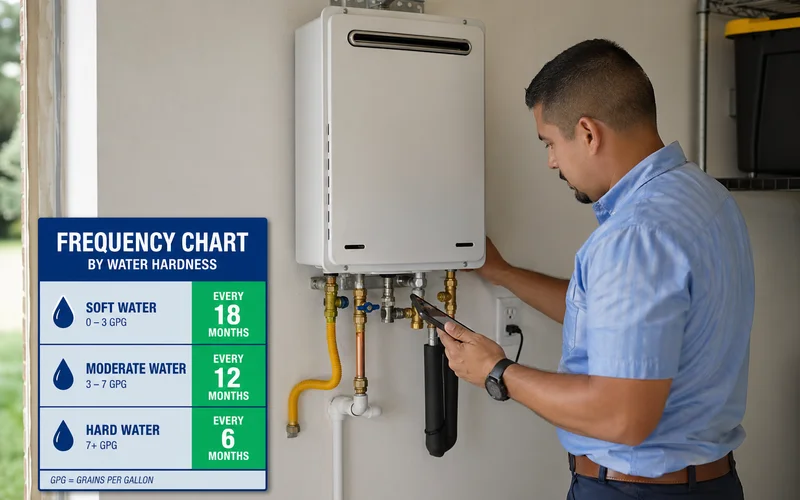
The ideal tankless flush frequency ranges from every 6 months for extreme hard water to every 18 months for soft water. A yearly flush remains the standard baseline for most homes across the US.
Our technicians rely on precise Grains Per Gallon (GPG) measurements to dictate this schedule. Water exceeding 10.5 GPG requires aggressive maintenance to prevent internal damage.
We use this specific table to map out the exact timing for our service calls.
| Water Hardness | Flush Frequency | Notes |
|---|---|---|
| Soft (under 4 grains/gallon) | Every 18 months | With softener: every 24 months |
| Standard (4-7 grains/gallon) | Annual | Default for most regions |
| Hard (7-10 grains/gallon) | Annual | With softener: every 18 months |
| Very Hard (10-15 grains/gallon) | Every 6 months | Sustained 20-year life requires this |
| Extreme (15+ grains/gallon) | Every 4-6 months | Phoenix, Las Vegas, San Antonio |
Hard-Water Region Map
Cities with water hardness above 15 GPG require tankless flushing every six months to survive. Locations with standard water hardness between 4 and 7 GPG can safely rely on an annual service appointment.
Our local water quality reports show that the Southwest and Midwest sit on massive limestone formations. This geology dissolves heavy amounts of calcium and magnesium directly into the groundwater.
We constantly see the impact in cities drawing from the mineral-dense Colorado River. Las Vegas tap water routinely tests over 300 parts per million, which translates to a massive 17.6 GPG.
San Antonio pulls from the Edwards Aquifer, pushing local readings past 16.5 GPG. Indianapolis and central Indiana counties pull from surface creeks that push hardness up to 20.4 GPG.
Our service teams mandate a 6-month flushing cadence in these extreme zones:
- Phoenix metro, Tucson: 15-20+ grains/gallon
- Las Vegas valley, Reno: 15-20+ grains/gallon
- Salt Lake Valley, Utah Valley: 15+ grains/gallon
- San Antonio, Austin: 15+ grains/gallon
- Hill Country TX, Dallas: 10-15 grains/gallon
- Central Indiana counties: 10-15 grains/gallon
- Central Florida counties: 10-15 grains/gallon (Tampa reaches 17 GPG in dry seasons)
Coastal and volcanic regions usually benefit from naturally softer water. You can safely stick to annual flushing in these locations:
- Most of California (varies dramatically by district)
- Most of Massachusetts, New York, Pennsylvania
- Coastal North Carolina, Florida
- Most of Maryland, Virginia
- Colorado Front Range
We always recommend testing your exact supply to be certain. For more on regional water specifics, see our hard water tankless descaling guide.
How Whole-House Softeners Change the Math
A properly sized whole-house water softener pushes your required flushing schedule back by at least six months. These systems remove over 90 percent of dissolved calcium, but they do not eliminate the need for regular maintenance completely.
Our crews often hear from customers who assume a softener makes their tankless unit invincible. That is a dangerous myth.
While salt-based systems prevent dense limestone scaling, they still allow some sediment to pass through to the pressure regulator.
We adjust our maintenance schedules based on the presence of a functioning softener. The adjusted timelines look like this:
- Soft to Standard regions: extend to a 24-month cadence
- Hard regions: shift to annual instead of semi-annual
- Very Hard regions: shift to semi-annual instead of quarterly
If you are wondering when to descale tankless units, an annual flush remains a highly effective preventive baseline regardless of your setup. Taking an hour to clear out residual grit prevents sensor failures and irregular heating down the road.
What Manufacturers Say
Every major manufacturer explicitly ties their warranty coverage to a strict, region-appropriate flushing schedule. Skipping these mandatory descaling intervals will usually result in an immediate claim denial if your heat exchanger fails.
Our service records prove that brands track this maintenance closely during warranty disputes. Mineral scale leaves an obvious, undeniable chalky residue inside the copper piping.
Manufacturers specify these common patterns in their official 2026 manuals:
- Rinnai: Annual service required, with semi-annual intervals mandated in hard-water areas.
- Navien: Annual flushing, shifting to semi-annual if water hardness exceeds 8 grains/gallon.
- Noritz: Annual baseline, requiring homeowners to consult their installer in hard-water regions.
- Rheem: Annual baseline, with semi-annual strongly recommended in TX, AZ, NV, IN, and UT.
- Thermomate: Recommends flushing immediately if error codes like E3 or LF appear, indicating flow restriction.
We rely on specialized products like the Hercules Haymaker Kit or 4 gallons of food-grade white vinegar to meet these factory standards. The manufacturer will request proof of this exact service history if you ever need a major component replaced.
What Skipped Flushes Cost
Skipping your required flush creates a cascading financial disaster that ends with replacing the entire unit. A single missed year simply causes a slight dip in efficiency, while four missed years usually destroys the heat exchanger completely.
Our pricing data from 2026 shows that an average professional flush costs between $150 and $250. Ignoring this small fee leads to massive repair bills.
A severely scaled heat exchanger forces the unit to burn much hotter to reach your desired temperature.
We track the exact timeline of how this damage escalates:
- One year skipped in hard water: Scale layer increases slightly, easily recovering with a standard vinegar flush.
- Two years skipped: Scale grows thicker, requiring an extended 60-minute circulation with a commercial descaler to clear.
- Three years skipped: Scale hardens into a permanent shell, causing irregular temperatures and initial heat exchanger damage.
- Four+ years skipped: Heat exchanger fails entirely, often totaling the unit.
Replacing a ruined gas tankless unit in 2026 runs between $2,100 and $5,600 for parts and labor. A simple annual service call is the cheapest insurance policy you can buy for your plumbing system.
Booking the Right Schedule
The easiest way to protect your system is to automate your maintenance schedule based on your exact ZIP code. A professional can calculate your local water hardness and set up a recurring service cadence that fits your specific needs perfectly.
Our flushing and descaling service handles all the scheduling logistics so you never miss a deadline. If you live in a brutal 6-month zone like San Antonio, the system alerts you exactly when it is time.
We never oversell maintenance to customers in forgiving water districts. If an annual flush is plenty for your neighborhood, that is exactly what your profile will recommend. When determining how often to flush a tankless water heater, setting up a reliable reminder system is the smartest move you can make. It guarantees your expensive equipment actually survives to see its twentieth birthday.
Frequently Asked Questions
How do I know my water hardness?
Does a water softener replace the need to flush?
What if I skip flushing for a year?
Related Guides
DIY Tankless Flushing Risks vs Professional Service
DIY flushes commonly miss flow direction, cabinet cleaning, filter replacement, or unit reset — often leaving scale behind. When DIY pays vs when it costs more.
Hard Water and Tankless Descaling Requirements
TX, AZ, IN, NV, UT have widespread hard water that destroys unflushed tankless units. Scale-inhibitor and softener options, signs, and cost consequences.