
DIY flushes that miss critical steps
Wrong flow direction, cabinet not cleaned, filter not swapped, counter not reset. Skip any one and the work doesn't fully count for warranty.
Professional descaling, internal cabinet cleanup, and filter replacement — the highest-impact single service for hard-water homes.
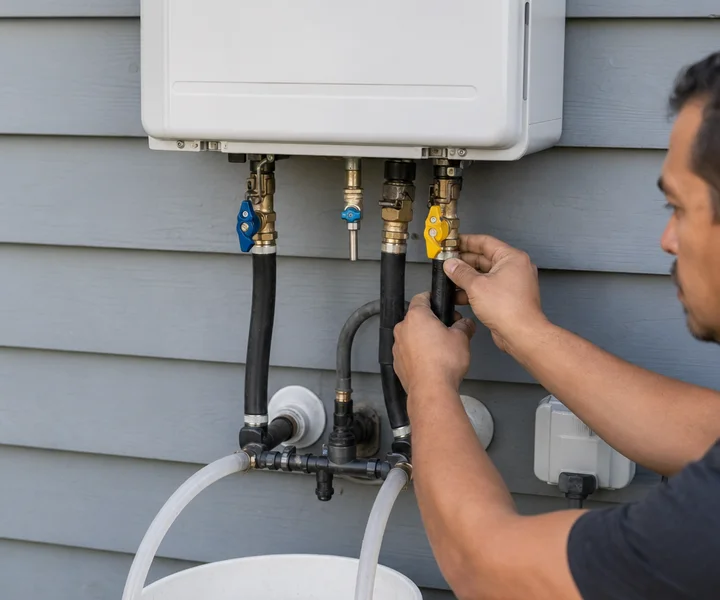
The four issues homeowners run into most when shopping tankless flushing & descaling. We solve all of them up front.
Wrong flow direction, cabinet not cleaned, filter not swapped, counter not reset. Skip any one and the work doesn't fully count for warranty.
Manufacturers want documented professional flushing. DIY records typically fail the audit, which is why so many claims get rejected.
Manufacturer-approved descaler at the right concentration matters. We use what's spec'd for your unit, not whatever's on the truck.
In Phoenix, Las Vegas, San Antonio, and Salt Lake Valley, semi-annual descaling is the only realistic path to a 20-year unit life.
Have you ever turned on the shower expecting warm water, only to get an icy blast? Professional Tankless Flushing & Descaling solves this frustrating problem.
Calcium scale buildup on a tankless water heater’s heat exchanger is the single most common cause of premature failure.
We see this issue happen constantly in US hard-water states. This mineral buildup is often the difference between a full 20-year lifespan and a unit failing at just 10 years. Manufacturer warranty validity also frequently depends on having this professional service documented on the books.
Our descaling service is a 60-minute, six-step process that catches the critical details DIY attempts usually miss. You will find that regular maintenance saves you a massive headache later. Grab a cup of coffee, and let us go through the process together.
Buy a descale kit at the home improvement store, and you will get a basic pump, a bucket, and some instructions. Those printed guides usually leave out critical information. Manufacturers like Rinnai and Navien actually have specific error codes that trigger when maintenance is done incorrectly.
We regularly see homeowners make well-intentioned mistakes that end up causing expensive damage. A very common error involves using a flushing pump that is much too powerful. Many forum users suggest using a 1/3 horsepower sump pump pushing 40 gallons per minute (GPM). That intense pressure can actually damage the delicate 1/2-inch copper pipes inside the heat exchanger. A gentle pond pump rated under 500 gallons per hour (GPH) is a much safer choice.
Here are the critical details standard instructions usually miss:
Miss any one of these steps, and the work does not fully count. Manufacturer warranties almost always require documented professional service for heat exchanger claims. This strict policy explains why many homeowners who flush their units religiously still get warranty claims denied.
The actual flushing process requires precision and the right chemicals to be fully effective. Standard white vinegar takes a very long time to dissolve heavy calcium deposits. We use manufacturer-approved, professional-grade descalers like Flow-Aide or Haymaker. These specialized formulas safely strip away scale much faster than grocery store vinegar.
Our technicians follow a strict protocol to ensure your system runs like new. This routine prevents common issues, like the Rinnai ‘LC’ error code that flashes when the heat exchanger suffers from scale buildup. Another major benefit is preventing flame rod failure. Navien units often suffer from a flame loss error (Code E012) specifically because carbon and scale coat the sensitive flame rod.
Here is exactly how the process works:
| Step | What Happens | Why It Matters |
|---|---|---|
| 1. Isolate and drain | Shut off gas and water, drain via service valves | Safety + ensures full descaler access |
| 2. Connect descale loop | Pump + manufacturer-approved descaler in correct direction | Removes calcium without damaging exchanger |
| 3. Cabinet clean | Vacuum and wipe internal burner area | Restores combustion efficiency |
| 4. Inlet filter swap | Remove, inspect, replace or clean | Restores full flow + prevents false fault codes |
| 5. Air filter check | Clean or replace intake filter | Combustion air integrity |
| 6. Service counter reset | Reset unit’s internal maintenance counter | Keeps warranty status current |
Every flush ends with a brief flow-rate test and a written record of the work performed. That written record is exactly what manufacturers want to see if a warranty claim ever comes up.
The frequency of your maintenance depends entirely on the mineral content of your local water supply. The United States Geological Survey (USGS) released updated data in 2026 showing severe hard water issues across the country. Water containing over 180 Parts Per Million (PPM) of dissolved minerals is classified as “Very Hard.”
We service properties in states like Arizona, Nevada, and Texas that regularly test between 200 and 350 PPM. This extreme mineral density means scale forms incredibly fast inside the heating elements.
If you are in one of our 15 served states, here is the typical recommendation by region:
For region-specific detail, see our hard water tankless descaling guide. Our installer recommendations always factor in your exact local water hardness levels. Customizing the schedule protects your investment.
Ignoring maintenance is a gamble that rarely pays off for property owners. Standalone flushing runs $125 to $250 per visit across the US. The higher end of that price scale is reserved for severe scale buildup or units that have missed service for years.
We highly recommend bundling this service with your annual plumbing maintenance. Bundled flushing is typically included in a $175 to $350 comprehensive service visit. That is a massive bargain compared to the alternative. If a heat exchanger cracks from overheating, a total replacement unit easily costs $2,000 to $4,500.
A $200 maintenance visit is always better than a $4,000 emergency replacement.
If you are a year or two overdue for Tankless Flushing & Descaling, book your service right now. Recovery is usually possible if you act quickly. Waiting another year often crosses the threshold where heat exchanger damage becomes permanent, and a complete replacement is your only option.
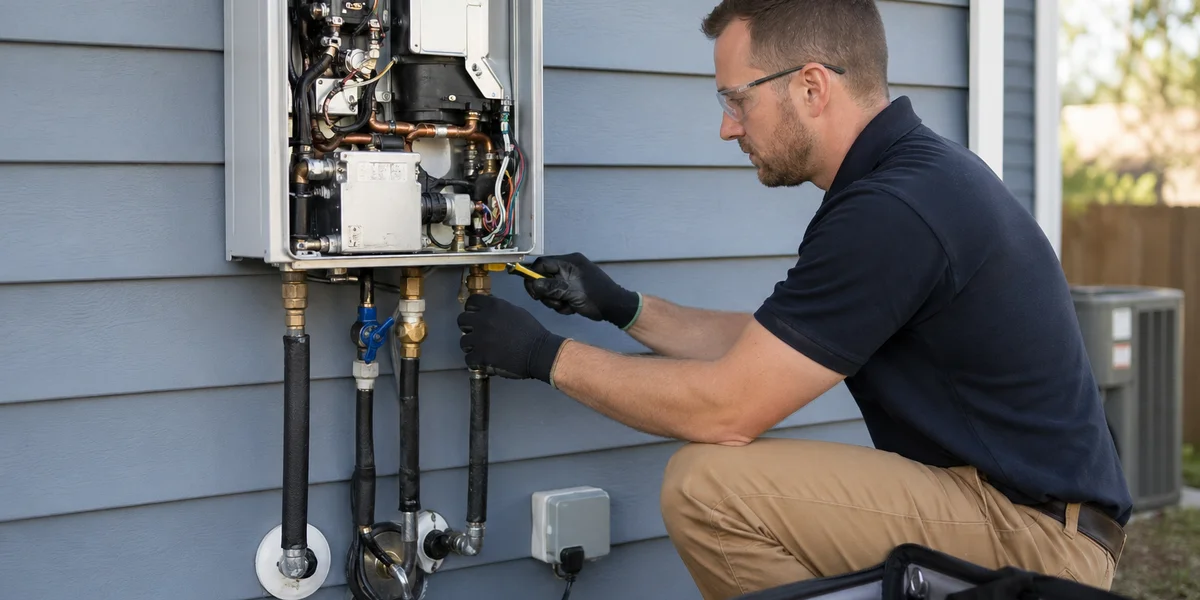
No in-home sales pitch. Just a virtual quote, a vetted local plumber, and a documented job.
Standalone flush or bundled with annual maintenance. Most jobs scheduled within the same week, sooner in hard-water states.
Approved descaler in correct flow direction, at the right concentration, for the right duration. About 60 minutes per unit.
Internal clean, inlet filter swap, intake filter check, and service counter reset. The five steps a DIY flush usually misses.
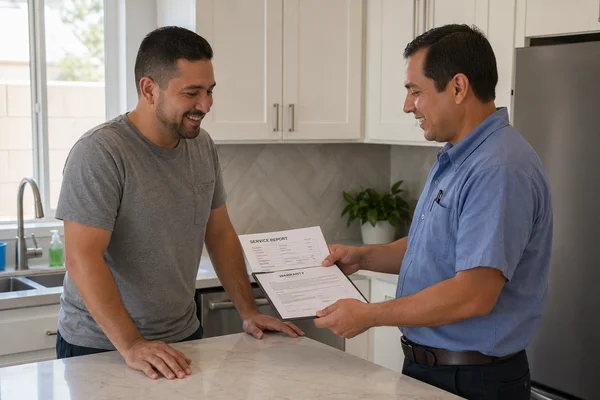
Quick performance test confirms the work, plus written documentation for any future warranty filing on the heat exchanger.
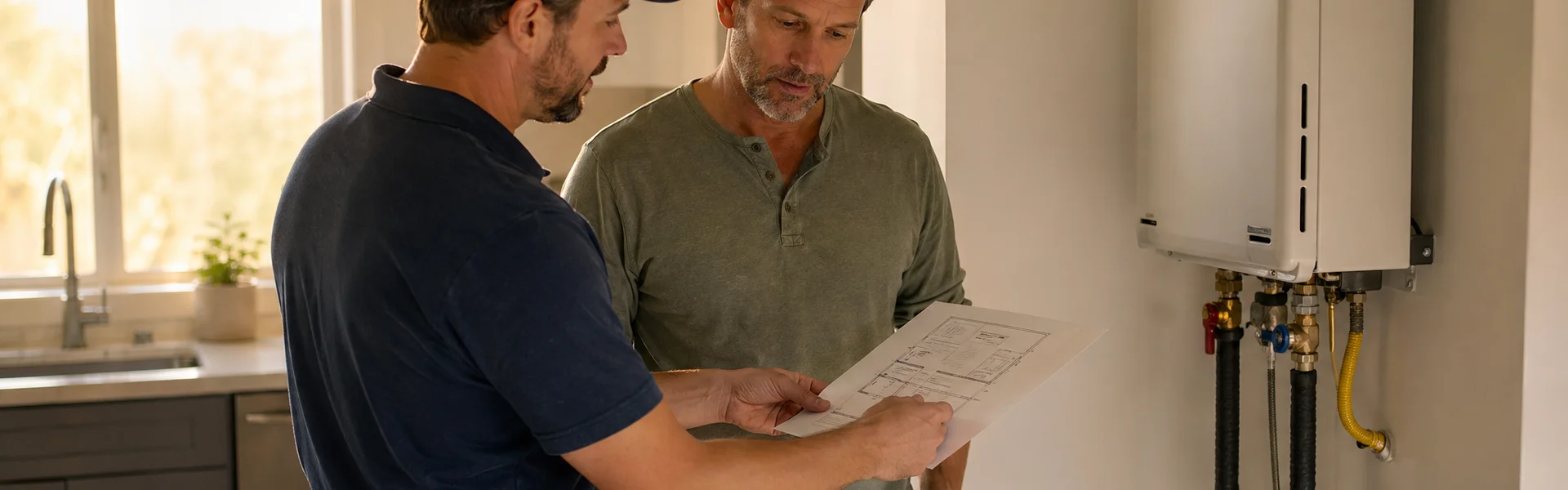
Tell us about your home and unit. We match you with a vetted local plumber and a transparent price range. No commitment, no pressure call.
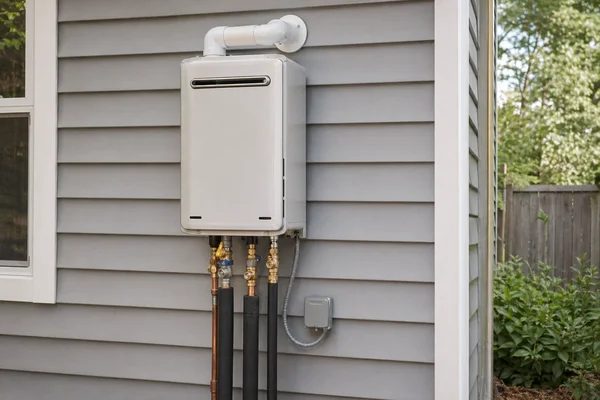
A look at the kind of work our vetted local installers deliver.
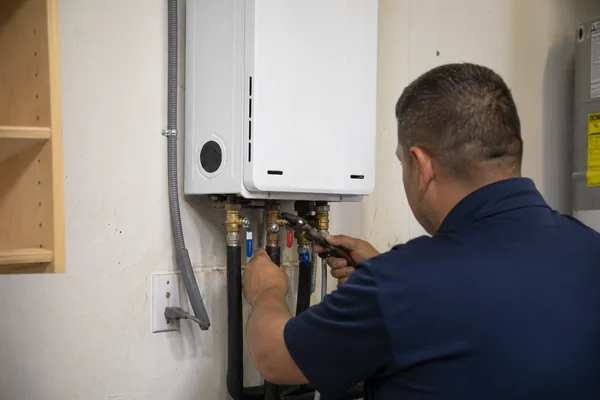
Real reviews from homeowners who trusted us with their tankless installation, repair, and maintenance.
"Live in Phoenix, water hardness is brutal. Booked an annual descale and the technician explained why my last DIY flush probably didn't actually move scale through the system. Real expertise, wish I'd called sooner."
David T.
February 2026
"I had three other plumbers tell me my Noritz needed replacement. Total Tankless found it was a clogged inlet filter, a $45 fix instead of a $5,000 rip-out. That's the brand-neutral expertise this market needs."
Amanda H.
November 2025
Quick answers about our tankless flushing & descaling service.
Brand-neutral, homeowner-first reading on the questions that come up most before booking tankless flushing & descaling.
TX, AZ, IN, NV, UT have widespread hard water that destroys unflushed tankless units. Scale-inhibitor and softener options, signs, and cost consequences.
Read Guide → Reference GuideAnnual baseline, every 6 months for hard water (>10 grains/gallon). How softeners change the cadence and what skipping costs you in warranty.
Read Guide → Decision GuideDIY flushes commonly miss flow direction, cabinet cleaning, filter replacement, or unit reset — often leaving scale behind. When DIY pays vs when it costs more.
Read Guide →End-to-end tankless installation through our vetted nationwide plumber network: sizing, permits, gas line, venting, and commissioning.
Learn More →Comprehensive annual maintenance — flush, descale, filter, vent inspection, leak check, performance test — that extends unit life past 20 years.
Learn More →Specialty diagnostics and repair for every major tankless brand: error codes, ignition failure, scaling, leaks, mid-use shutdowns, and more.
Learn More →
Get a fast virtual estimate from a vetted local plumber who actually specializes in tankless. No pressure, no in-home pitch.