
How Often Should I Service My Tankless Water Heater?
Annual baseline, every 6 months in hard-water states. Why skipping service voids warranty and shortens lifespan from 20+ years to tank-equivalent.
5 min read
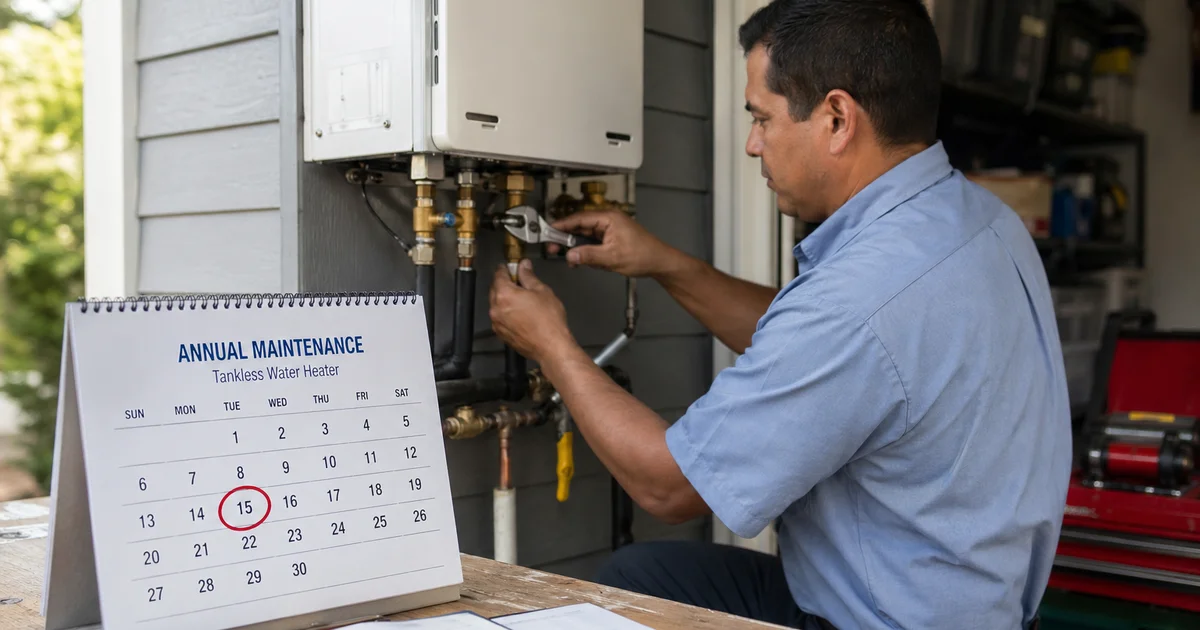
Our service technicians hear the same question from property owners almost every day. You might be wondering how often service tankless water heater systems actually require to stay operational.
The factory promises a twenty-year lifespan for these units.
We know from field experience that skipped maintenance is the main reason these heaters fail at year twelve instead. A lack of routine flushing allows hard water minerals to destroy the internal heat exchanger.
Our goal is to help you protect that expensive upfront plumbing investment. Let us break down the exact maintenance schedule your system needs based on local water quality data.
The Baseline Schedule
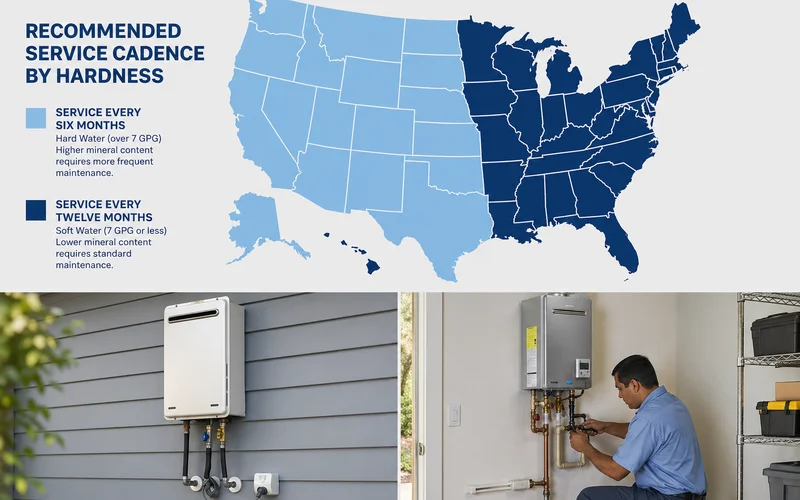
The standard baseline schedule for most US homes is one annual flush. Your exact frequency will depend entirely on the grains per gallon (GPG) of mineral hardness in your municipal water supply.
We rely on this specific cadence to keep units running safely and efficiently. An overwhelming 85 percent of the United States deals with hard water according to recent USGS data.
Local technicians use the following timeline based on regional water testing.
| Water Type | Service Frequency | The “Why” Behind the Schedule |
|---|---|---|
| Soft water (under 7 GPG) | Every 18 months | Slow mineral accumulation |
| Standard (7-10 GPG) | Annual | Default manufacturer recommendation |
| Hard (10-15 GPG) | Every 6 months | Faster scale accumulation |
| Very hard (15+ GPG) | Every 4-6 months | Aggressive, rapid scale accumulation |
We see the fastest scale buildup in major southwestern and midwestern hubs. Hard-water regions where a strict six-month cadence applies include the Phoenix metro area (12 to 17 GPG), the Las Vegas valley (up to 16 GPG), and San Antonio (15 to 20 GPG).
Central Indiana counties like Indianapolis also push 20 GPG, making twice-a-year flushing mandatory.
Why Cadence Matters So Much
Calcium scale buildup on the primary heat exchanger is the top cause of premature tankless failure. Mineral deposits act as a thick layer of insulation between the heating element and your water.
We watch these units lose efficiency rapidly when service is delayed. Scale does not build at a flat rate.
Field diagnostic tools show that existing scale provides a textured surface for new minerals to cling to faster. A unit that skips a required six-month flush will have more than double the scale at month twelve.
Here is how the damage progresses when you skip routine flushing:
- Month 6 to 12: Microscopic calcium layers begin coating the heat exchanger, forcing the burner to work harder.
- Month 12 to 18: Flow rates drop as minerals clog internal pipes, causing water temperature fluctuations.
- Month 18 to 24: Thick scale triggers internal sensors to shut the unit down, risking permanent heat exchanger cracks.
We see the damage multiply quickly in hard-water states. Two years of skipped flushing can drop a unit’s total life expectancy from twenty years down to ten.
Brands like Noritz actually build scale-detection software into their modern units to warn you before this catastrophic damage occurs. The entire upfront premium you paid for a tankless system gets wiped out by a few missed maintenance visits.
What Skipped Service Costs
Skipped service costs homeowners hundreds of dollars in lost efficiency and emergency repairs. The financial math always favors keeping a strict maintenance schedule.
We tell every customer to look at the hard numbers for 2026. Angi data shows a professional flush averages between $150 and $250.
Repair logs confirm that ignoring this small fee leads to massive downstream expenses. Beyond a shortened lifespan, missing your service window triggers several expensive problems.
- Voided Manufacturer Warranties: Major brands like Rinnai and Navien explicitly state that damage from hard water deposits, lime, or scale buildup instantly voids their heat exchanger warranty.
- Reduced Energy Efficiency: A scaled exchanger transfers heat poorly, forcing the system to burn more gas or electricity to reach your set temperature.
- Higher Repair Frequency: Scale-related faults trigger frustrating digital error codes and cause sensitive internal sensors to burn out prematurely.
- Premature Component Replacement: Replacing a cracked heat exchanger costs $500 to $1,300, compared to a simple $200 preventive flush.
Annual vs 6-Month Service Logic
When deciding how often service tankless water heater units need, the logic between annual and six-month frequency comes down to your local risk factors. An annual visit is the absolute minimum requirement to keep your factory warranty active.
We recommend annual maintenance for homes with soft water or a dedicated whole-house water softening system. This single visit catches early-stage issues and keeps the internal computer happy.
Technicians take a different approach for homes without softeners in mineral-heavy regions.
Annual Service Benefits
- Perfect for soft and standard hardness regions under 7 GPG.
- Fulfills the basic warranty requirements for Navien and Rinnai.
- Keeps energy bills stable by clearing minor sediment.
6-Month Service Protocol
- Required to hit a 20-year design life in hard water cities.
- Prevents catastrophic heat exchanger cracking.
- Usually combined with one full annual maintenance and one quick flush-only visit.
How to Know If You’re Hard-Water
You can determine your water hardness by checking public utility reports or using a simple chemical test. Anything above 7 grains per gallon counts as hard for tankless plumbing purposes.
We advise property owners to test their supply before finalizing a maintenance plan. Levels above 10 grains per gallon mean you should immediately schedule six-month flushing intervals.
Three simple ways exist to verify your specific numbers.
- Check your utility water quality report: Search your city name followed by “water quality report” online to find the exact parts per million (PPM) or GPG.
- Buy a $10 test strip: Hardware stores sell instant test kits that give you an accurate reading in seconds.
- Look for visual household indicators: Heavy soap scum, spotty dishes, and white crust on your bathroom faucets all point to high mineral content.
Documentation Matters
Documentation proves to the manufacturer that you maintained the equipment properly if a part fails. Every single service visit must generate a detailed, dated invoice.
We tell clients to file these receipts immediately because warranty departments will ask for them. A proper record is your only defense against a denied claim.
These standard service invoices always include a few specific details.
- Date and technician name
- Specific work performed (descale, filter swap, combustion check)
- Flow rate measurement
- Any wear or issues identified
- Recommendation for next service
We strongly suggest keeping these records safe. They are exactly what the manufacturer wants to see if a heat exchanger claim ever comes up.
Review our maintenance checklist guide to see what a real service should cover.
For booking annual or semi-annual service, our maintenance service sets up reminders so you never forget the schedule.
Conclusion
Knowing exactly how often service tankless water heater systems require maintenance is the key to protecting your home. A proactive approach saves you from cold showers and massive repair bills.
We encourage you to check your local water hardness today. Call a licensed professional to get your next flush on the calendar.
Frequently Asked Questions
Will my warranty be voided if I skip annual service?
How do I know if my water is hard?
Can I skip a year if everything seems fine?
Related Guides
DIY Tankless Flushing Risks vs Professional Service
DIY flushes commonly miss flow direction, cabinet cleaning, filter replacement, or unit reset — often leaving scale behind. When DIY pays vs when it costs more.
Hard Water and Tankless Descaling Requirements
TX, AZ, IN, NV, UT have widespread hard water that destroys unflushed tankless units. Scale-inhibitor and softener options, signs, and cost consequences.
Signs Your Tankless Water Heater Needs Maintenance Now
Reduced flow, longer warm-up, error codes, audible scaling, lukewarm output — each tied to root cause. When to book service before damage cascades.
Annual Tankless Water Heater Maintenance Checklist
Step-by-step what a proper annual tankless service covers: descale, filter, vent, combustion, leak check, performance test. What cheap providers skip.