
Annual Tankless Maintenance Checklist
Step-by-step what a proper annual tankless service covers: descale, filter, vent, combustion, leak check, performance test. What cheap providers skip.
6 min read
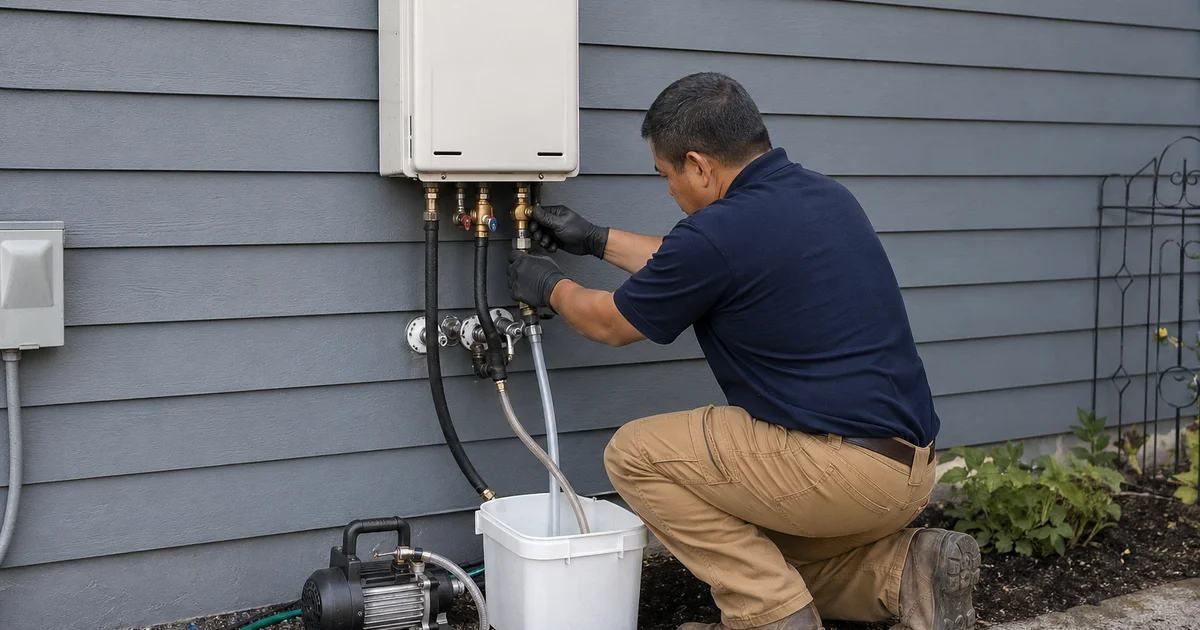
You know how a cheap oil change often skips the essential filter and fluid checks? Tankless water heater service works the exact same way.
As a professional service team, our technicians frequently see property owners pay for a basic flush, assuming they bought total system protection. That cheap “annual tankless service” usually means running some solution through the lines and nothing else. The reality is that skipping the full inspection leaves critical components completely vulnerable.
Real maintenance requires six detailed steps that take 60 to 90 minutes and end with a comprehensive written report.
Let’s examine the hard data behind equipment failures, and then walk through the exact tankless water heater maintenance checklist your service provider needs to follow.
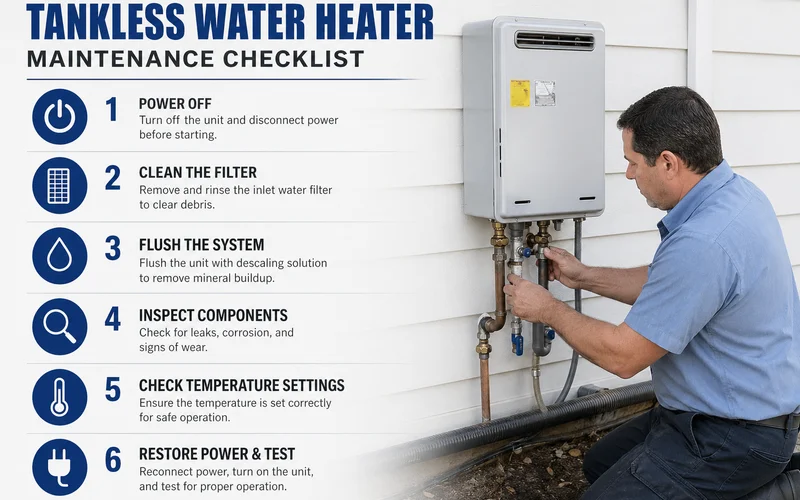
The Six-Step Tankless Water Heater Maintenance Checklist
A professional tankless water heater maintenance checklist breaks down into six specific actions. This detailed process goes far beyond a simple flush to ensure every component functions safely.
Step 1: Descale and Flush
A professional descale and flush removes hardened calcium from the heat exchanger using a specialized acidic solution. This prevents the mineral buildup that causes overheating and sensor failures.
Our service teams find that roughly 85 percent of US homes have hard water, meaning the mineral content exceeds seven grains per gallon. The technician circulates four gallons of food-grade white vinegar or a manufacturer-approved descaler through the unit in reverse flow. This chemical process takes 30 to 45 minutes to dissolve stubborn scale.
Without this step, calcium acts as a thick insulator inside the heat exchanger. The unit works harder to heat the water, which often triggers an over-temperature fault code and eventually cracks the metal.
Step 2: Inlet Filter Clean or Replace
Cleaning the cold water inlet filter restores full water pressure and prevents false error codes. Technicians remove, inspect, and rinse this small mesh screen during every maintenance visit.
Municipal water lines across the country carry debris that destroys internal valves, including:
- Microscopic sand
- Hardened mineral flakes
- Municipal pipe sediment
Our plumbers frequently resolve low-flow complaints simply by cleaning a clogged inlet filter. A blocked screen restricts water flow enough to drop system performance, which can lead to an unnecessary $150 to $200 diagnostic charge. The actual cleaning process takes only five to ten minutes.
Step 3: Air Intake Filter Clean
Rinsing the exterior air intake screen guarantees the combustion chamber receives enough oxygen. A blocked intake starves the burner and kills heating efficiency.
Modern high-efficiency condensing units require unobstructed airflow to maintain their 90-plus percent efficiency ratings. Dust, pollen, and pet hair accumulate rapidly on these exterior screens over a single year.
Our standard protocol involves vacuuming or rinsing the screen completely. A clean intake ensures a steady combustion air supply, and the process takes just five minutes.
Step 4: Vent and Combustion Inspection
A combustion inspection uses a calibrated analyzer to verify the system burns fuel safely. This step ensures dangerous exhaust gases vent completely outside your building.
US safety guidelines recommend specific thresholds to prevent carbon monoxide poisoning indoors:
| CO Level (ppm) | Safety Status |
|---|---|
| 0 - 10 ppm | Normal ambient safety range |
| 400+ ppm (Exhaust) | Severe hazard requiring immediate shutdown |
Our specialized combustion analyzer detects hazardous fuel-air ratios instantly. The visual inspection also covers the vent termination and intake screen, taking about 10 to 15 minutes.
Step 5: Leak and Worn-Part Audit
A visual leak audit checks the internal components for early signs of moisture. Spotting a tiny drip now prevents catastrophic water damage later.
Ignoring a slow leak often ruins the primary heat exchanger completely. Replacing that single component averages $600 to $1,300 in the US today.
Our detailed inspection documents any minor wear that warrants tracking for the next visit. The technician specifically checks:
- All interior water fittings
- The pressure relief valve
- The primary heat exchanger jacket
- Condensate drain lines (on high-efficiency models)
This careful audit takes five to ten minutes, but it keeps future repair costs remarkably low.
Step 6: Performance and Flow-Rate Test
Measuring the hot water output at a sustained 120°F confirms the system operates at peak capacity. This final test compares current performance against the factory specifications.
A unit struggling to hold temperature usually suffers from internal scale or a failing flow sensor. Tracking this performance data year-over-year reveals subtle degradation trends before they trigger a complete shutdown.
Our final step guarantees the equipment delivers the volume of hot water you expect. This test takes 10 to 15 minutes and provides hard numbers on your system’s health.
What Cheap Providers Skip
Bargain providers skip crucial diagnostic tests and filter swaps to keep their prices artificially low. A basic flush leaves your system at risk for undetected failures and safety hazards.
A “flush-only” service usually costs around $99 to $125, but the technician rarely opens the cabinet to inspect the components. This approach ignores combustion drift and minor water leaks.
These bargain providers typically skip:
- The inlet filter swap (which is usually clogged after a year)
- The combustion analysis (leaving you with no CO/CO2 safety reading)
- The comprehensive leak audit (providing only a quick visual at the exterior fittings)
- The flow-rate measurement (offering no year-over-year performance tracking)
- The detailed written report
Our industry experience shows that these shortcuts lead directly to the “50 percent rule” in plumbing repairs. A neglected unit eventually requires emergency fixes costing more than half the price of a brand-new installation. You also face severe warranty risks because there is no documentation of proper care.
What You Should Get From a Real Service
A legitimate maintenance visit concludes with a detailed, written service report for your records. This paperwork proves to the manufacturer that you maintained the equipment properly.
Wondering exactly what is included in tankless service when done right? After the visit, you should hold a physical or digital document outlining every test performed.
Your final documentation should include:
- A written service report with the date, technician name, and specific actions taken
- The flow rate measurement recorded at full operation
- A combustion analysis printout for gas-powered units
- Detailed filter condition notes indicating what was replaced or cleaned
- A recommendation for the next service based on your local water hardness
- A list of any wear items identified for future tracking
Our management team constantly reminds property owners that verbal confirmation means nothing to a manufacturer. If you do not get the paperwork, the service did not happen as far as the warranty department is concerned.
Why This Protects Your Warranty
Documented annual service prevents manufacturers from denying expensive warranty claims due to neglect. Keeping strict maintenance records keeps your parts and labor coverage fully intact.
Most major-brand warranties contain strict language stating that coverage is conditional on documented annual professional maintenance. Brands like Navien and Rinnai explicitly void their warranties if a failure stems from scale buildup or improper care.
“Skipping annual maintenance is the single most common reason manufacturers deny heat exchanger warranty claims.”
When a heat exchanger fails at year eight, the manufacturer immediately asks for your service records. If you have them, you typically receive a covered repair and only pay for labor.
Our customers save thousands of dollars simply by keeping their service invoices in a folder. Years of cheap $99 flushes with no paperwork can equal a $1,500 out-of-pocket repair because the warranty was invisibly voided.
What Real Maintenance Costs
A comprehensive six-step service typically costs between $175 and $350 in the US, depending on unit accessibility. This investment secures your warranty and maximizes the lifespan of your system.
If you live in a region with severe water hardness exceeding 10 grains per gallon, you may require semi-annual service to keep the heat exchanger clear. A professional tankless tune up checklist requires specialized chemicals, expensive combustion analyzers, and a licensed technician’s time.
Our planned service agreements often reduce these expenses significantly. Maintenance plans generally run 15 to 25 percent below ad-hoc, per-visit pricing, and they usually include priority scheduling.
| Service Type | Average US Cost | Benefits |
|---|---|---|
| Ad-Hoc Visit | $175 - $350 | Standard 6-step service, standard scheduling |
| Maintenance Plan | 15% - 25% less | Includes priority scheduling and annual tracking |
See our maintenance cost guide for plan vs ad-hoc math. For booking, our maintenance service handles all six steps with documented reports every visit.
Frequently Asked Questions
How long does tankless maintenance take?
Should I get a service report?
What's the difference between maintenance and flushing?
Related Guides
DIY Tankless Flushing Risks vs Professional Service
DIY flushes commonly miss flow direction, cabinet cleaning, filter replacement, or unit reset — often leaving scale behind. When DIY pays vs when it costs more.
Hard Water and Tankless Descaling Requirements
TX, AZ, IN, NV, UT have widespread hard water that destroys unflushed tankless units. Scale-inhibitor and softener options, signs, and cost consequences.
How Often Should I Service My Tankless Water Heater?
Annual baseline, every 6 months in hard-water states. Why skipping service voids warranty and shortens lifespan from 20+ years to tank-equivalent.
Signs Your Tankless Water Heater Needs Maintenance Now
Reduced flow, longer warm-up, error codes, audible scaling, lukewarm output — each tied to root cause. When to book service before damage cascades.