
Signs Your Tankless Needs Maintenance Now
Reduced flow, longer warm-up, error codes, audible scaling, lukewarm output — each tied to root cause. When to book service before damage cascades.
5 min read
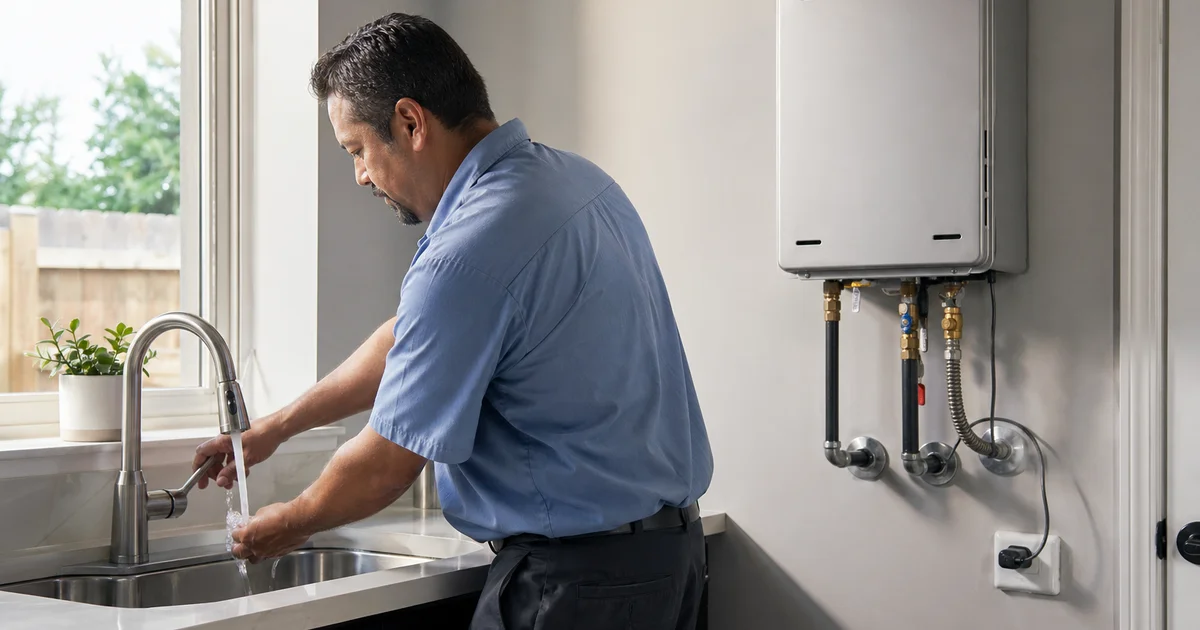
Our team often sees tankless water heaters hide their wear and tear remarkably well. This equipment masks degradation until a minor issue becomes a complete breakdown.
You might think everything is fine until the shower suddenly runs cold.
We know that waiting for a total failure usually leads to a much higher repair bill. Data from 2026 shows that routine maintenance costs between $150 and $350 in the US, while major repairs quickly exceed $1,000. Catching the signs tankless needs maintenance early is the best way to avoid those massive costs.
We will break down exactly what to look for and how to respond before a minor hiccup becomes a major headache.
The Seven Warning Signs
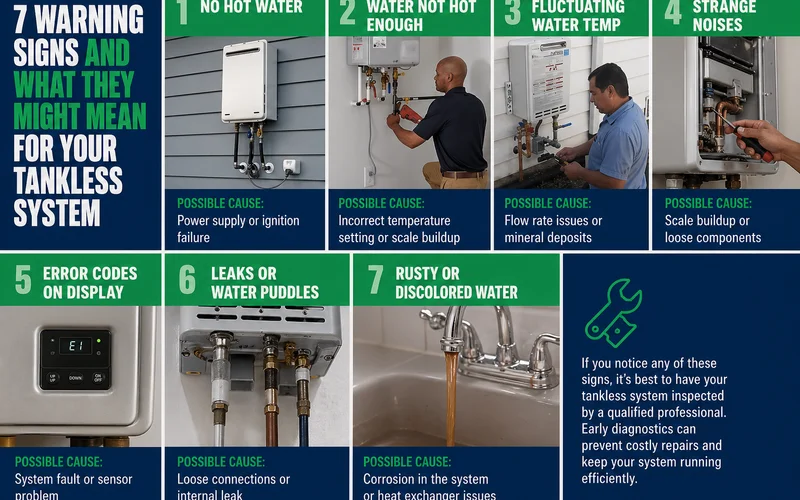
The primary signs tankless needs maintenance include reduced flow, delayed heating, error codes, and unusual noises. Our technicians use these early indicators to diagnose units before critical components fail. Noticing these shifts early dictates exactly when to service tankless systems in your home.
1. Reduced Flow at Hot Taps
A sudden drop in hot water pressure usually points straight to a clogged inlet screen filter or severe scale buildup. Fixing an inline filter takes about five minutes, while scale requires a full flush.
Our field crews always check the cold water inlet filter first during a service call. If the filter is clear, hard water scale is likely choking the heat exchanger and reducing your total gallons per minute (GPM) output.
Here are the most common culprits for low flow:
- Blocked inline screen filters
- Aerator clogs at the actual fixture
- Scale restricting the internal copper piping
- A failing flow sensor
Ignoring a flow drop forces the unit to work harder to push water through the narrowed passages.
2. Longer Warm-Up Time Before Hot Water Arrives
A lag time stretching from the normal 5 to 10 seconds out to 20 or 30 seconds clearly indicates poor heat transfer. This delay happens when thick mineral deposits coat the heat exchanger and block the burner’s energy from reaching the water.
We frequently see this extended warm-up period in homes with long plumbing runs. The unit simply cannot heat the water fast enough to overcome the cold water sitting in the pipes. A degraded flow sensor might also fail to tell the system to fire up immediately.
A standard professional descaling service clears the mineral barrier and restores the original rapid heating performance.
3. Intermittent Error Codes That Clear With Reset
Error codes that flash and disappear after a quick reboot are early warnings of component strain. A temporary code means the system detected a fault, but the issue has not completely disabled the unit yet.
Our repair logs show that a Navien E030 or a Rinnai Code 16 often points directly to dangerous scale buildup inside the heat exchanger. Power-cycling the unit might bring the hot water back for the morning shower.
The underlying restriction remains and will eventually trigger a permanent lockout. Always document the exact code displayed on the digital panel. You can give that specific code to a technician to speed up the diagnostic process.
4. Audible Scaling (Popping or Knocking Sounds)
Knocking, popping, or ticking sounds coming from the cabinet mean water is boiling around hardened mineral deposits. This noise always signals severe scale accumulation that demands an immediate descaling flush.
We find that roughly 85% of US households deal with hard water. Water containing more than 7 grains per gallon of hardness will rapidly calcify inside a high-efficiency heater.
Those popping noises happen when calcium carbonate flexes and expands under intense heat. If you ignore the racket, the localized hot spots will eventually crack the metal heat exchanger.
5. Lukewarm-Only Output at Peak Demand
Water running lukewarm when multiple fixtures are open means the heater has hit its maximum capacity. This happens due to an undersized unit, restricted gas flow, or a modulating burner that cannot reach high fire.
Our crews use specialized digital combustion analyzers to determine why a burner is underperforming. A unit rated for 7 GPM might only deliver 4 GPM if scale has insulated the heating elements.
Peak US morning usage times quickly expose these hidden efficiency losses. A thorough maintenance visit will confirm whether the unit needs a deep clean or a gas pressure adjustment.
6. Increased Gas Usage Without Demand Change
A sudden spike in your gas bill without a change in household habits suggests a severe efficiency loss. The water heater is burning more natural gas just to achieve the same water temperature.
We calculate that a heavily scaled heat exchanger can drop a unit’s efficiency from 95% down to 70% or lower. The system runs much longer cycles to compensate for the poor heat transfer.
You end up paying for wasted energy every time a hot tap opens. Comparing your current utility statement to the same month last year makes it easy to spot this hidden cost.
7. Visible Scale at Cold Inlet or Hot Outlet Fittings
White or chalky beige crust appearing on the exterior water connections means your system is well past due for service. Visible calcium carbonate on the outside indicates that the internal buildup is significantly worse.
Our plumbers know that surface crust is just the tip of the iceberg. The narrow passages inside the heat exchanger are likely choked with hard mineral deposits.
Professional maintenance uses specific solutions like Flow-Aide or food-grade white vinegar to safely dissolve these blockages. Scheduling a flush immediately is the only way to prevent a total blockage.
What Each Sign Says About Urgency
You must address these tankless maintenance warning signs based on a specific timeline to avoid permanent damage. Delaying service usually turns a simple maintenance appointment into a costly parts replacement.
Our team relies on this urgency matrix to prioritize service calls. Follow this timeline to determine when to service tankless units in your home or business.
| Sign | Urgency | Action |
|---|---|---|
| Reduced flow | 30 days | Maintenance call, check filter first |
| Longer warm-up | 30 days | Maintenance with descaling |
| Intermittent error codes | This week | Maintenance + diagnostic |
| Knocking/popping sounds | 30 days | Schedule descaling |
| Lukewarm output | This week | Diagnostic to distinguish causes |
| Higher gas usage | 30 days | Maintenance with combustion check |
| Visible scale at fittings | This week | Descaling overdue |
What Waiting Costs
Ignoring the signs tankless needs maintenance sets off a predictable cascade of component failures. A minor flow restriction today translates directly into a major structural failure down the road.
We track repair data across the US, and a neglected heat exchanger is the most expensive consequence. A cracked heat exchanger requires specialized parts and extensive labor.
Recent 2026 data shows that replacing this single component now costs between $600 and $1,300. Here is exactly how waiting multiplies your repair bill:
- Reduced flow: A dirty filter is a fast and cheap fix. Severe scale eventually causes a heat exchanger crack costing $600 to $1,300.
- Longer warm-up: This degrades the flow sensor and causes modulating burner wear before total component failure.
- Knocking sounds: Ongoing scale accumulation directly leads to a cracked heat exchanger.
- Lukewarm at peak: Continuous burner wear forces a premature replacement need.
- Higher gas usage: Ongoing efficiency loss creates a massive cumulative utility cost.
- Visible scale: You are already past a comfortable safety margin and need urgent descaling.
The pattern is perfectly clear. Most signs that point to maintenance now will demand an emergency repair if ignored for 6 to 12 months.
Catching It Early Saves Money
Booking a preventive service appointment is vastly cheaper than paying for emergency repairs. A standard six-step maintenance visit in the US currently costs roughly $150 to $350 and addresses most of these signs before they cause damage.
Our standard procedure includes a full system flush and diagnostic check. Waiting until a heat exchanger cracks pushes your bill well past the $1,000 mark. You can easily protect your investment by acting at the first sign of trouble.
For what a real maintenance visit covers, see our maintenance checklist guide. For booking, our maintenance service prioritizes appointments for homeowners noticing the earliest signs tankless needs maintenance.
Frequently Asked Questions
Is a noisy tankless always a problem?
How long can I wait if I notice these signs?
Will maintenance fix all of these?
Related Guides
DIY Tankless Flushing Risks vs Professional Service
DIY flushes commonly miss flow direction, cabinet cleaning, filter replacement, or unit reset — often leaving scale behind. When DIY pays vs when it costs more.
Hard Water and Tankless Descaling Requirements
TX, AZ, IN, NV, UT have widespread hard water that destroys unflushed tankless units. Scale-inhibitor and softener options, signs, and cost consequences.
How Often Should I Service My Tankless Water Heater?
Annual baseline, every 6 months in hard-water states. Why skipping service voids warranty and shortens lifespan from 20+ years to tank-equivalent.
Annual Tankless Water Heater Maintenance Checklist
Step-by-step what a proper annual tankless service covers: descale, filter, vent, combustion, leak check, performance test. What cheap providers skip.