
Are Tankless Water Heaters Worth It?
An honest breakdown of when tankless pays off and when it doesn't. Continuous hot water, 20+ year lifespan, real upfront costs, and the homeowner profiles where it makes sense.
8 min read

Are tankless water heaters worth it? We field this question daily from homeowners and business owners comparing replacement options.
The sticker shock of an on-demand system definitely catches people off guard.
Our team finds that the real deciding factor is how long you plan to hold onto the property. Let’s look at the 2026 data and see what it actually tells us. We can then explore a few practical ways to see if this upgrade fits your needs.
What You Actually Get From Tankless
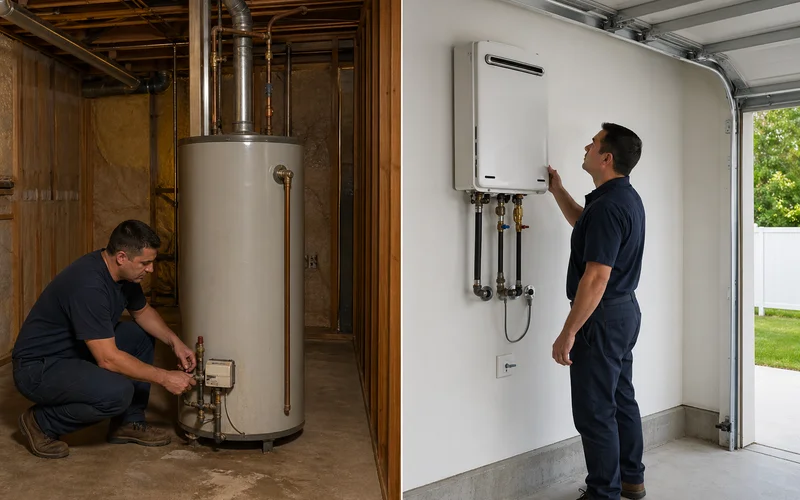
Continuous hot water is the most common selling point. We prefer to highlight the massive long-term advantage of equipment lifespan. A standard storage tank from brands like Bradford White or Rheem typically lasts 8 to 12 years before requiring a swap. Our technicians regularly see properly maintained tankless units, like the Rinnai or Navien condensing models, hit the 20-year mark. That extended lifespan means you skip an entire replacement cycle. We see customers save around $1,500 to $3,000 in future equipment and labor costs.
We also need to look at the daily operating efficiency. Gas tankless models with a Uniform Energy Factor (UEF) of 0.95 or higher run significantly cheaper than standard tanks. Our clients often save between $100 and $200 annually on their gas bills. These high-efficiency systems avoid the constant standby heat loss. A 50-gallon tank constantly burns energy to keep water hot around the clock. We can summarize these differences in a quick comparison. The numbers below highlight the baseline expectations for a typical household.
| Feature | Standard Gas Tank | High-Efficiency Gas Tankless |
|---|---|---|
| Average Lifespan | 8 to 12 Years | 20+ Years |
| Annual Savings | Baseline | $100 to $200 |
| Hot Water Supply | Limited (50 Gallons) | Continuous |
The Honest Cost Reality
A full professional tankless conversion currently runs between $3,500 and $6,500. We see prices drop to the $2,000 to $3,800 range for a simple tankless-to-tankless swap. A direct tank-for-tank replacement only costs about $1,500 to $3,000. This creates a clear upfront premium. We tell customers that this premium is exactly what needs to pay for itself over time. The Federal IRA Section 25C tax credit remains a massive help in 2026. It offers up to $600 back for qualifying models. We break down the most common modification costs below.
- Gas Line Upgrades: Increasing capacity to handle up to 199,000 BTUs.
- Electrical Additions: Installing a dedicated 120V outlet for the digital control board.
- Venting Modifications: Routing new PVC exhaust pipes directly outside.
This structural work explains why the initial conversion is a larger investment. Our tankless rebates and tax credits guide covers the stacking math by state. These combined incentives shrink the gap between a traditional tank and a modern on-demand system.
When Tankless Doesn’t Pay Off
Certain scenarios make this upgrade a poor financial decision. We actively discourage clients from installing these systems if they fall into a few specific categories. The upfront cost simply fails to pay off under the following conditions. We break down the most common dealbreakers below.
You Are Moving Soon
A new on-demand system provides a modest tankless water heater value bump of roughly $500 to $1,500 during a home sale. We find that homeowners moving within three or four years never recover their initial investment. The true financial return relies on years of stacked utility savings.
Your Home Lacks Natural Gas
Our electricians frequently quote an additional $2,000 to $4,000 for required electrical panel upgrades. Whole-house electric models demand massive amounts of power. They pull 120 to 150 amps for several key components.
- High-draw heating elements
- Digital control boards
- Advanced sensor systems
We see this extra panel expense completely destroy any potential return on investment.
You Have Minimal Hot Water Needs
Single-occupant households running one shower a day rarely generate enough energy savings to justify the premium. We typically recommend a high-efficiency standard tank for these extremely low-usage situations. A smaller traditional unit will serve your daily needs for thousands of dollars less.
You Live in a Hard Water Region
Our service teams see heat exchangers fail rapidly in hard water regions if owners skip regular maintenance. Many parts of the US have water hardness levels exceeding 10.5 grains per gallon (GPG). We warn customers that manufacturers void warranties if you ignore the required semi-annual vinegar flushing. A standard tank is often the smarter choice if you want to avoid this routine descaling.
The Decision in a Sentence
We always tell clients that tankless systems are phenomenal investments if you meet the right criteria.
If you have natural gas, plan to stay five more years, and commit to maintenance, the upgrade makes sense. Our tank vs tankless guide offers a great side-by-side look at the tankless water heater pros and cons if you need more details.
The math definitely gets tighter for homes that fall outside that ideal profile.
We provide a free virtual estimate through our tankless installation service to help you review the exact numbers. Reach out today to see exactly how much you can save with current local rebates.

Frequently Asked Questions
How much can a tankless save me on my energy bill?
How long do I need to stay in my home for tankless to pay off?
Is tankless worth it if my water is very hard?
What if I'm only going to be in my home 3-4 years?
Related Guides
Best Tankless Water Heater Brands Compared (2026)
Brand-neutral comparison of Rinnai, Navien, Noritz, Rheem, Bosch, and AO Smith tankless water heaters. GPM ranges, warranties, where each excels.
How Does a Tankless Water Heater Work? (Beginner-Friendly)
Plain-English explanation of tankless water heater technology — on-demand heating, modulating burners, GPM ratings, and why there's no standby energy loss.
How Long Do Tankless Water Heaters Last? (Real Numbers)
Tankless water heaters last 20+ years with proper care, but skipped maintenance can cut that in half. Real lifespan numbers, key longevity factors, and brand warranty terms.
Tank vs Tankless Water Heater: 2026 Head-to-Head Comparison
Direct comparison of tank vs tankless water heaters: cost, lifespan, space, efficiency, hot-water capacity. Decision matrix to find the right fit for your home.