
Tank vs Tankless Water Heater
Direct comparison of tank vs tankless water heaters: cost, lifespan, space, efficiency, hot-water capacity. Decision matrix to find the right fit for your home.
9 min read
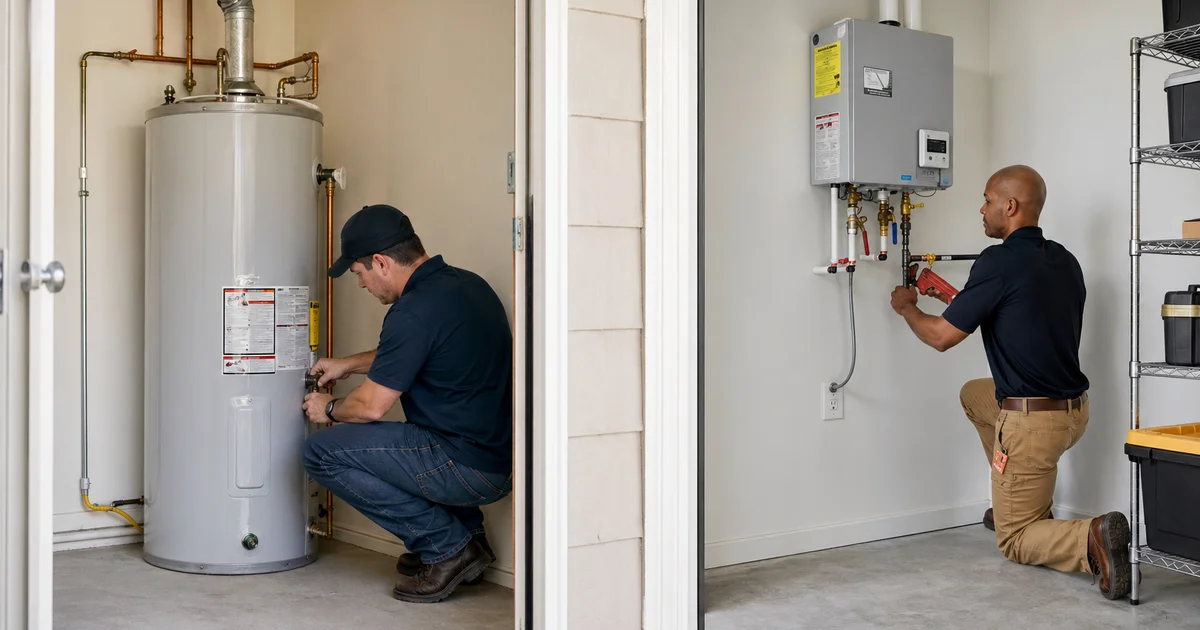
Our team sees the same debate unfold in utility rooms every single week.
A simple water heater replacement quickly spirals into a complex choice about long-term home infrastructure. You have to weigh immediate costs against future savings.
We will break down the exact numbers you need to make a smart choice for your property. This tank vs tankless water heater comparison looks at the five true trade-offs between the systems.
The Five-Way Tank vs Tankless Water Heater Comparison
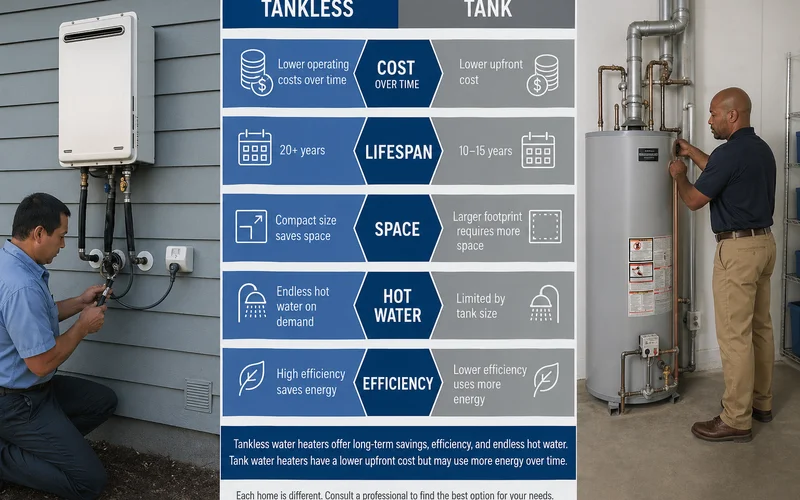
The tankless vs tank debate hinges on your budget and space. A standard 50-gallon tank costs less upfront. A tankless model demands a higher initial investment for endless hot water.
We created this clear breakdown so you can see the core differences at a glance.
| Category | Tank Water Heater | Tankless Water Heater |
|---|---|---|
| Upfront installed cost | $1,500-$3,000 | $3,000-$9,000 |
| Lifespan | 10-12 years | 20+ years with maintenance |
| Space footprint | 50-80 gallon vertical floor unit | Wall-mount, ~2.5 sq ft |
| Hot water capacity | Limited by tank size; refill lag | Continuous, GPM-limited only |
| Efficiency | 60-70% UEF gas; 90%+ electric | 80-95%+ UEF; no standby loss |
Those top-line numbers give you the basic picture. The specific details below will help you apply these figures to your exact situation.
Upfront Cost
When pricing a tankless or tank water heater, expect to pay between $1,500 and $3,000 to install a standard tank. A new tankless conversion ranges from $5,000 to $9,000. Upgrading to a tankless unit often requires new gas lines and dedicated electrical circuits.
Our crews complete a standard tank-for-tank swap in about half a day. A first-time tank-to-tankless conversion takes significantly longer. Installers must run larger gas pipes, map out new venting routes, and handle condensate drainage.
Replacing an existing tankless unit with a new one costs much less, usually landing between $3,000 and $5,500.
Cost Drivers for Tankless Conversions
- Gas Line Upgrades: Tankless units burn hotter and faster, often demanding a jump from a 1/2-inch to a 3/4-inch gas line.
- Electrical Panel Updates: Even gas tankless systems require power for electronic ignition and freeze protection.
- Custom Venting: High-efficiency condensing units require special PVC or CPVC venting to safely exhaust acidic exhaust gases.
The premium for going tankless sits between $1,500 and $5,000 in most markets. That extra cost must pay for itself over the lifespan of the equipment.
We used to rely on the federal IRA Section 25C credit to offset this difference. The One Big Beautiful Bill Act officially terminated that specific tax program at the end of 2025.
State and local utility rebates still offer excellent ways to reduce the sting. Programs vary by location, but some local utilities provide rebates of up to $1,000 for high-efficiency natural gas models.
Lifespan and Lifecycle Math
A standard storage tank lasts 10 to 12 years. A well-maintained tankless unit can serve your property for over two decades. Factoring in this lifespan gap makes the higher upfront cost of tankless much more appealing.
Our maintenance records show that location plays a massive role in longevity. Hard water destroys traditional tanks rapidly. In areas with heavy mineral content, you might replace a standard tank every seven to ten years.
A tankless system avoids that constant corrosive soaking. You can push a tankless heater past 20 years with proper care.
Maintenance Requirements
Tankless longevity is not automatic. It requires regular attention to combat scale buildup.
- Annual Descaling: Hard water areas require a yearly 60-minute flush with white vinegar or a specialized descaling solution.
- Professional Servicing: Hiring a professional plumber for this annual flush generally costs between $150 and $350.
- Filter Checks: The inline screen filter needs regular clearing to maintain high water pressure.
The math becomes clear when you view it on a 20-year timeline.
We often see homeowners buy two traditional tanks in the time it takes to wear out one tankless system. You avoid paying for a second $1,500 to $3,000 replacement.
Hot Water Capacity
Tank systems offer a fixed reserve of 50 or 80 gallons. Tankless units provide an endless stream constrained only by their flow rate. Sizing your system correctly guarantees you never face a cold shower.
A standard tank delivers exactly what it stores. If you run the dishwasher, start a load of laundry, and jump into the shower, you will quickly drain a 50-gallon supply. The unit then needs time to reheat a fresh batch of cold water.
Tankless heaters measure output in gallons per minute instead of total volume. A typical 9 to 11 GPM tankless unit from brands like Navien or Rinnai easily handles two showers and a kitchen sink running at the same time.
Capacity Comparison by Appliance
| Appliance | Average Flow Rate | Impact on System |
|---|---|---|
| Standard Showerhead | 2.0 to 2.5 GPM | Drains tank slowly; easy for tankless |
| Modern Dishwasher | 1.0 to 1.5 GPM | Minimal impact on either system |
| Washing Machine | 1.5 to 2.0 GPM | Drains tank fast; negligible for tankless |
We recommend checking the groundwater temperature in your specific region. Colder incoming water forces the heat exchanger to work harder, which slightly lowers your maximum GPM output.
If you have four or more bathrooms pulling hot water simultaneously, you will likely need a unit rated for 11 or more GPM. You can refer to our tankless sizing guide for the exact calculations.
Space and Install Location
Traditional tanks consume a significant chunk of floor space. Tankless units mount neatly on the wall. This size difference frees up valuable square footage in garages, basements, and utility closets.
A conventional vertical tank requires a footprint of four to six square feet. It dominates the corner of any room.
A modern tankless unit takes up roughly 2.5 square feet of wall space.
Popular Installation Spots for Tankless
- Utility Closets: Easily replaces a bulky tank and frees up floor storage.
- Exterior Walls: Outdoor mounting is a fantastic option in warmer climates to save indoor space completely.
- Basements: Clears up room for finishing a basement or adding a workbench.
Our installation teams frequently mount these compact boxes right out of the way. This slim profile is a major win for urban condos or properties with tiny basements.
You can even install exterior-mounted tankless units in warmer climates. This approach removes the appliance from your living space entirely.
Efficiency
Tankless water heaters are inherently more efficient because they eliminate standby heat loss. You stop paying to keep a massive steel drum of water hot 24 hours a day.
A traditional unit constantly fires up to maintain the temperature of its 50-gallon reserve. The Department of Energy points out that this standby loss is a major drain on household energy budgets.
Tankless systems bypass this issue entirely. The burners ignite only when you turn on a hot water tap. They shut off the exact second you close the faucet.
Measuring Efficiency: UEF Ratings
The Uniform Energy Factor measures how efficiently an appliance converts energy into hot water.
- Standard Gas Tanks: Typically sit between 0.60 and 0.70 UEF.
- Standard Electric Tanks: Often reach 0.90+ UEF, but electricity costs more per unit than gas.
- Condensing Gas Tankless: Achieve 0.90 to 0.95+ UEF by recycling exhaust heat.
Our clients typically see a 24% to 34% drop in water heating energy costs after switching to an on-demand system. Energy Star data confirms this level of savings for properties using under 41 gallons of hot water a day.
Gas tank units usually carry a Uniform Energy Factor between 0.60 and 0.70. High-efficiency condensing tankless units hit Uniform Energy Factor ratings of 0.90 to 0.95 or higher, converting nearly all their fuel into usable heat.
Decision Matrix
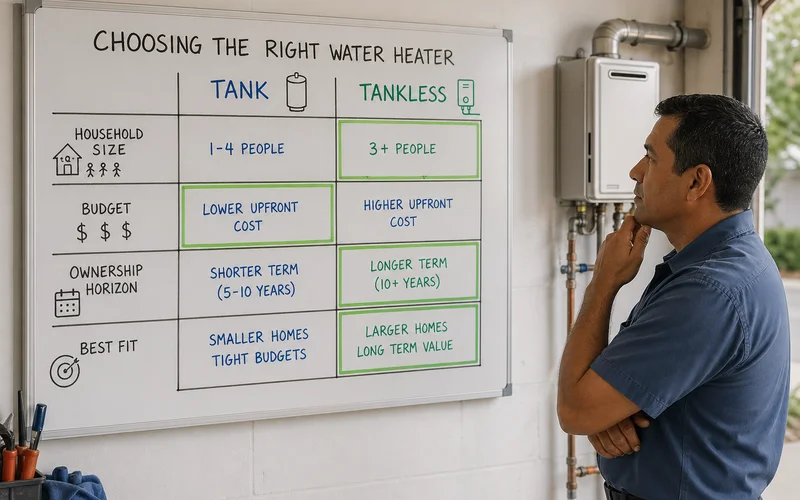
Your final choice depends on your timeline, your budget, and your daily habits. Both systems offer clear advantages for different types of properties.
Comparing traditional vs tankless models, choose a traditional tank if you plan to move within the next four years. It makes sense for homes with low hot water demand or properties lacking natural gas access. A tank saves you the massive expense of upgrading your electrical service.
Quick Decision Guide
- Choose a Tank If: You plan to move in less than five years, have low hot water demand, or want to avoid electrical panel upgrades.
- Choose Tankless If: You plan to stay long-term, have existing natural gas service, and are comfortable with annual descaling.
Go with a tankless unit if you intend to stay in your home for five or more years. It is the superior choice if you already have natural gas service and are willing to commit to annual descaling maintenance.
We created a specific breakdown for the financial side of this tank vs tankless water heater choice. The are tankless water heaters worth it guide walks through the exact payback windows.
Reach out to our team when you are ready to take the next step. Our tankless installation service gives you a free virtual estimate customized to your home’s unique layout.
Frequently Asked Questions
Does a tankless run out of hot water?
How much more does tankless cost than tank?
Can I replace a tank with a tankless myself?
Is a tank water heater ever the better choice?
Related Guides
Are Tankless Water Heaters Worth It? An Honest 2026 Breakdown
An honest breakdown of when tankless pays off and when it doesn't. Continuous hot water, 20+ year lifespan, real upfront costs, and the homeowner profiles where it makes sense.
Best Tankless Water Heater Brands Compared (2026)
Brand-neutral comparison of Rinnai, Navien, Noritz, Rheem, Bosch, and AO Smith tankless water heaters. GPM ranges, warranties, where each excels.
How Does a Tankless Water Heater Work? (Beginner-Friendly)
Plain-English explanation of tankless water heater technology — on-demand heating, modulating burners, GPM ratings, and why there's no standby energy loss.
How Long Do Tankless Water Heaters Last? (Real Numbers)
Tankless water heaters last 20+ years with proper care, but skipped maintenance can cut that in half. Real lifespan numbers, key longevity factors, and brand warranty terms.