
What Size Tankless Water Heater Do I Need?
Pick the right tankless GPM rating based on bathrooms, simultaneous fixtures, and climate. Sizing tables for typical homes plus a free calculator.
7 min read
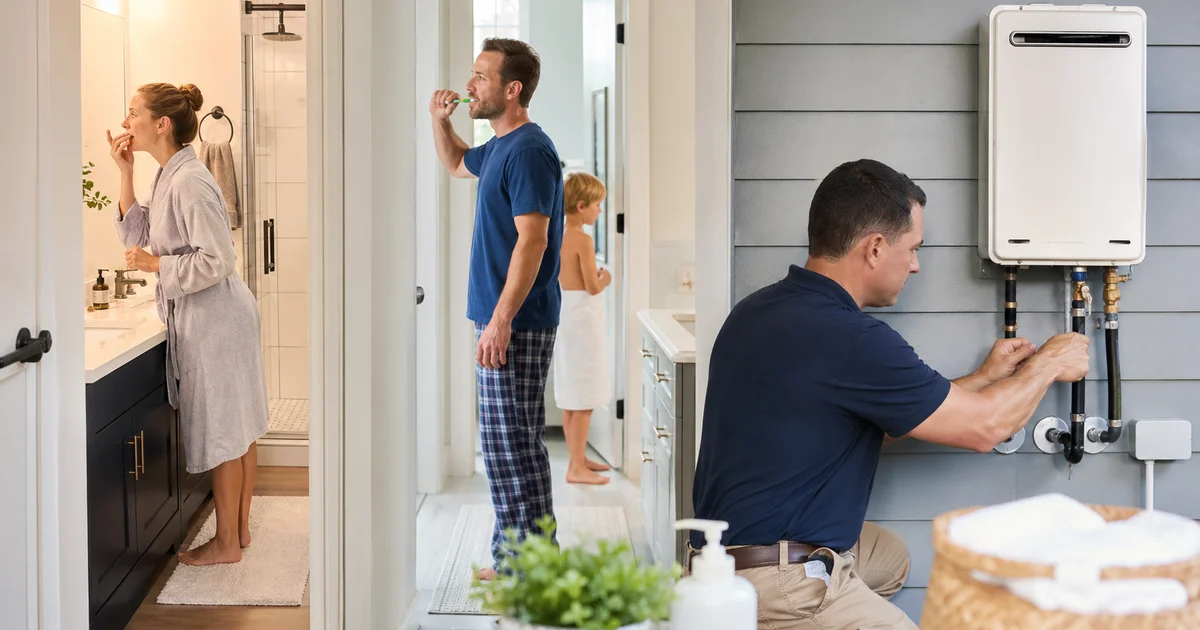
Undersizing is the number one installation mistake property owners make on a tankless system. We see this exact issue driving up service calls every single winter. A unit sticker claiming 9.8 GPM looks great on the box, but that rating relies on a tiny 35-degree Fahrenheit temperature rise.
You will get a much lower usable flow rate when cold water hits the system. People constantly ask us, what size tankless water heater do I need? We created this resource to answer that question and prevent costly installation mistakes.
Here is a complete breakdown of the mathematical sizing formula, typical fixture demand rates, and the required temperature rise for your specific region.
The Sizing Formula: What Size Tankless Water Heater Do I Need?
The required capacity of your tankless heater is determined by multiplying your simultaneous fixture demand by the required temperature rise. We calculate this by subtracting your incoming cold water temperature from your target output temperature. Industry data from 2026 shows that 37 percent of homeowners experience sizing issues within their first year of ownership.
Our specific sizing method prevents these frustrating hot water shortages. Most tankless brands, like Rinnai and Navien, publish GPM ratings based on a 35-degree or 50-degree rise. Real United States conditions often require a 60 to 90-degree rise during the winter months. This environmental reality significantly reduces the effective capacity of your heating unit.
Required GPM is determined by two main inputs:
- Simultaneous fixture demand (how many things might run at once)
- Rise temperature (output temperature minus your inlet water temperature)
You can use a digital tankless gpm calculator to speed up this process, but understanding the manual math guarantees accuracy. We strongly recommend doing these calculations by hand before making a major purchase.
Fixture Demand Reference
Your fixture demand is the total gallons per minute required when all your chosen fixtures run at the exact same time. We always add up the flow rates of your specific showers, sinks, and appliances to find this peak number. The Environmental Protection Agency WaterSense standard now requires new showerheads in the US to use no more than 2.0 GPM.
Our technicians often see older residential fixtures pulling up to 2.5 GPM. Upgrading to a 1.5 GPM low-flow showerhead can save an average family over 10,000 gallons of water per year. This simple fixture upgrade directly reduces the required size of your new water heater.
| Fixture | Typical GPM Use |
|---|---|
| Standard shower | 2.0-2.5 |
| EPA WaterSense shower | 2.0 |
| Low-flow shower | 1.5-1.8 |
| Bathroom sink | 0.5-1.0 |
| Kitchen sink | 1.5-2.5 |
| Dishwasher | 1.0-1.5 |
| Washing machine | 1.5-3.0 |
| Bathtub fill | 4.0+ (peak) |
A typical two-bathroom family with a morning routine needs about 6 to 7 GPM at the desired output. We calculate this baseline using two standard showers and a kitchen sink running simultaneously. Add a third simultaneous fixture, and the requirement quickly jumps to 8 or 9 GPM.
Inlet Temperature by US Region
The required temperature rise is your target hot water temperature minus your specific winter groundwater temperature. We usually set the target temperature to 120 degrees Fahrenheit for standard residential and commercial use. Cold northern climates require a massive temperature rise that significantly cuts a water heater’s output capacity.
Our local sizing charts always factor in these harsh winter conditions. In places like Massachusetts or Colorado, winter groundwater can drop to 35 or 40 degrees Fahrenheit. This freezing starting point means your system must generate a massive 80 to 85-degree rise.
| Region | Winter Inlet Temp | Required Rise (to 120°F) |
|---|---|---|
| Florida, AZ, southern CA, TX | 65-70°F | 50-55°F |
| NC, VA, NJ, NV, mid-CA | 60°F | 60°F |
| PA, MD, IN, NY upstate | 50°F | 70°F |
| MA, CO, UT mountain | 35-40°F | 80-85°F |
A unit rated for 9.8 GPM at a 35-degree rise performs very differently across the country. Our field data reveals exactly how this output drops based on your location.
- 7.0 GPM at a 50-degree rise (Florida or Arizona winters)
- 5.5 GPM at a 70-degree rise (Pennsylvania or Indiana winters)
- 4.2 GPM at a 90-degree rise (Massachusetts or Colorado winters)
Sizing Tables for Typical Homes
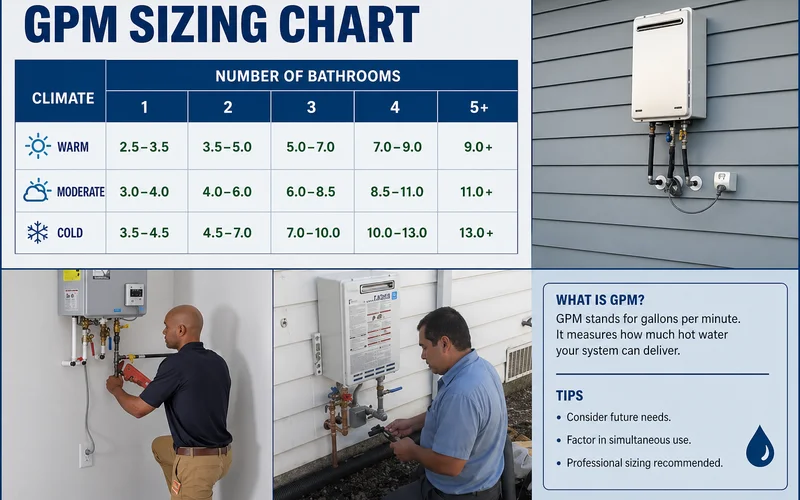
A typical three-bathroom home in a cold climate needs a tankless water heater capable of delivering 11 to 13 GPM. We recommend a smaller 6 to 7 GPM unit for homes with a single bathroom in warm climates. Gas units from brands like Navien or Rinnai are highly preferred for larger households because they can handle up to 199,000 BTUs.
Our installation teams use these high-capacity gas models to safely provide 9 or more GPM to larger properties. Whole-house electric tankless systems often max out at 8 GPM, making them less suitable for large homes in cold regions. Finding the right tankless size for 3 bathrooms usually requires a powerful gas unit or two smaller electric units.
| Bathrooms | Climate | Recommended GPM |
|---|---|---|
| 1 bath | Warm/Moderate | 6-7 GPM |
| 1 bath | Cold | 7-8 GPM |
| 2 bath | Warm/Moderate | 7-9 GPM |
| 2 bath | Cold | 9-11 GPM |
| 3 bath | Warm/Moderate | 9-11 GPM |
| 3 bath | Cold | 11-13 GPM |
| 4+ bath | Any | 11+ GPM (often two units in parallel) |
Why Undersizing Fails
An undersized tankless unit tries to keep up with demand by automatically reducing the output water flow or temperature. We regularly repair units that produce a frustratingly lukewarm output during peak morning hours. The system will restrict the water flow to maintain heat, resulting in a dribbling shower head.
Customers often blame the technology for these mid-shower temperature drops, but it is almost always a fundamental sizing error. Our technicians frequently encounter system error codes triggered by this exact restriction. Rinnai displays Code 18 or 65 when the system fails to detect enough water movement.
A Navien heater will throw an E011 or E039 code for the exact same flow limitation. This common dissatisfaction is why professional installation service starts with accurate GPM sizing during the estimate. We always run the math against your specific home, local ZIP code, and demand pattern before recommending a unit.
Can You Oversize?
Yes, you can oversize a tankless water heater, and it is usually a smart long-term decision. We strongly recommend going slightly larger because it prevents future hot water shortages during peak usage. Modulating gas burners easily scale down on low demand without any efficiency penalty.
A high-capacity 199,000 BTU gas unit typically costs just 300 to 500 dollars more upfront than a smaller 160,000 BTU model. Our teams find that this small equipment upgrade fee provides several major advantages.
- Less mechanical strain over the 20-year lifespan of the system.
- Reduced internal wear on the heat exchanger.
- Guaranteed hot water during unexpected high-demand days.
You must verify that your home has the proper electrical and gas line capacity to handle a larger system. We check these exact infrastructure requirements during every single site visit to ensure a safe upgrade. For the technical decision on your specific unit type once the size is known, see this comprehensive condensing vs non-condensing guide.
Conclusion
Finding the right water heater capacity comes down to accurate math and understanding your local climate. We hope this complete tankless sizing guide gives you the confidence to make a smart, data-driven choice for your property. A properly sized system will provide decades of reliable, endless hot water.
Do not let cold winter groundwater ruin your morning routine. Our experts are ready to help you calculate your exact needs so you never have to wonder what size tankless water heater do I need again. Contact us today to schedule your professional virtual estimate and secure your hot water supply.
Frequently Asked Questions
What GPM do I need for 2 bathrooms?
Can I oversize a tankless?
Does my climate really change sizing?
Related Guides
Condensing vs Non-Condensing Tankless: Which Is Right?
Condensing tankless units run 90%+ efficient with cheap PVC venting; non-condensing are 80-85% with stainless flue. Total-cost-of-ownership math inside.
Electric to Gas Tankless Conversion (Cost & Process)
Electric-to-gas conversions are the most expensive scenario — typically adding $1K-$2K. Why it still pencils out, what's involved, and propane as an alternative.
Gas Line Requirements for Tankless Water Heater Installation
Tankless units need a 3/4 inch gas line in most cases — your existing 1/2 inch line probably won't work. Here's how to know if you need an upgrade and what it costs.
How to Choose a Tankless Water Heater Installer
Questions to ask, red flags to avoid, and certifications that matter when picking a tankless installer. Why the cheapest quote is usually a warning.