
Condensing vs Non-Condensing Tankless Water Heaters
Condensing tankless units run 90%+ efficient with cheap PVC venting; non-condensing are 80-85% with stainless flue. Total-cost-of-ownership math inside.
7 min read
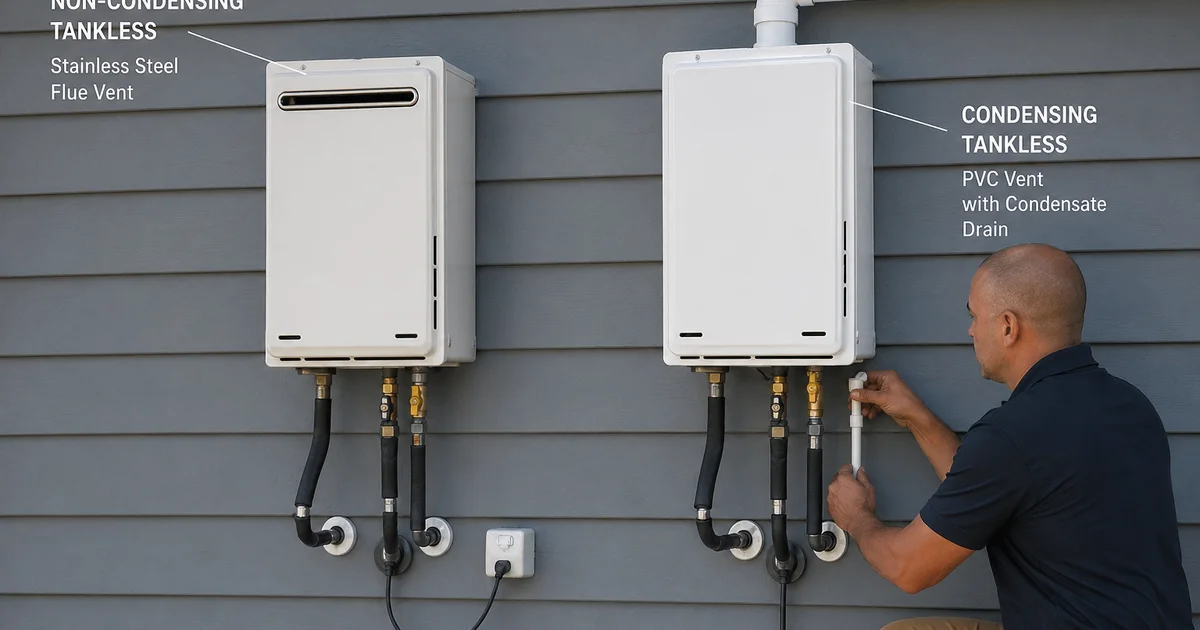
Choosing a condensing vs non condensing tankless unit is the most consequential technical decision you will make during your upgrade. The upfront price tag often points people in the wrong direction.
We see customers make this mistake almost every week. The real cost difference comes down to venting materials and long-term energy efficiency.
Let’s look at the actual data and installation costs. We will break down exactly which system makes sense for your US property and your budget.
The Core Difference
A condensing tankless water heater uses a second heat exchanger to extract more heat from the exhaust, while a non-condensing unit sends that hot exhaust straight outside. This extra step drastically changes the unit’s efficiency and installation requirements.
We find that the exhaust temperature tells the whole story. Non-condensing water heaters produce exhaust gases that run between 300 and 500 degrees Fahrenheit. All that wasted heat escapes your home.
A condensing model cools those same exhaust gases down to roughly 110 to 150 degrees Fahrenheit. The unit captures the remaining heat through a secondary stainless steel heat exchanger. This process creates acidic water vapor condensation inside the unit.
Here is how that translates to efficiency ratings:
- Condensing models: Typically achieve a 0.92 to 0.97 Uniform Energy Factor (UEF).
- Non-condensing models: Usually max out around a 0.80 to 0.85 UEF.
Our installation crews prefer the newer condensing systems like the Rinnai NPE-A2 series for their superior heat extraction.
The Cost Comparison
A non-condensing unit costs less out of the box, but the required stainless steel venting often makes the total installation much more expensive. A condensing unit costs more upfront but uses inexpensive PVC piping.
We always tell property owners to look at the total installed price. The unit price alone is a common trap.
| Factor | Condensing | Non-Condensing |
|---|---|---|
| Unit cost | $1,200-$2,500 | $700-$1,500 |
| Venting (per foot) | $3-$8 PVC | $25-$40 stainless |
| Condensate drain | $150-$300 added | None |
| Efficiency (UEF) | 0.92-0.97 | 0.80-0.85 |
| Annual energy use | 100% | 110-115% |
Look at the venting materials in that table. A typical 30-foot vent run costs $150 to $300 in Schedule 40 PVC. That exact same distance requires $750 to $1,200 in specialized Category III stainless steel for a non-condensing unit.
Our project managers usually see the math flip entirely during the planning phase. The net installation cost for a condensing system is often identical to or cheaper than a non-condensing setup once you factor in the exhaust path.
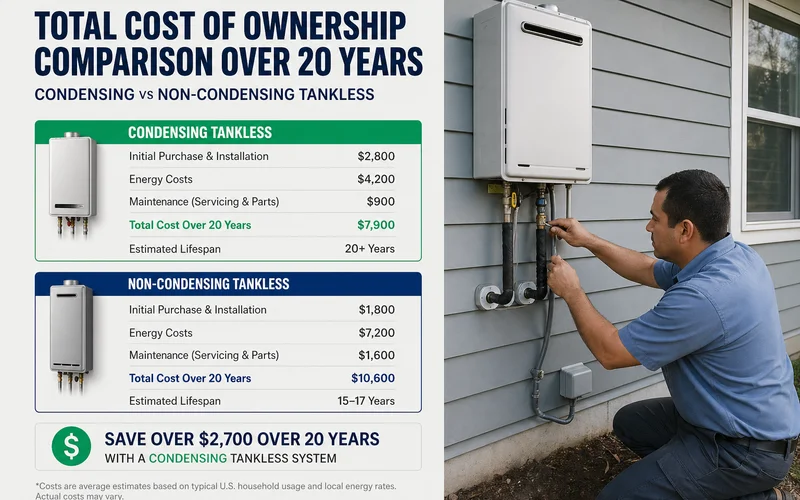
20-Year Total Cost of Ownership
A condensing unit will save the average US household between $2,000 and $4,000 in energy bills over its 20-year lifespan. These savings easily offset any initial hardware or condensate drainage costs.
Consider a standard winter gas bill of about $200 per month. The 10 to 15 percent efficiency advantage of a condensing model translates to $150 to $250 in annual energy savings.
The math becomes undeniable over two decades of use. You are looking at $3,000 to $5,000 in total energy savings.
Pro Tip: High-efficiency condensing units can cut your water heating bills by up to 30 percent compared to traditional storage tanks. This makes that 20-year window highly profitable.
We factor in a $300 to $700 unit premium and the one-time $150 to $300 condensate drain installation. The net return is still thousands of dollars in your pocket.
When Non-Condensing Still Makes Sense
A non-condensing unit is only the right choice if you have a very short vent run, lack access to a drain, or plan to move soon. For over 90 percent of residential installations, condensing is the clear winner.
There are three specific scenarios where an older-style unit still works:
- Very short vent run: A distance under 10 feet means the expensive stainless steel piping cost stays manageable.
- No practical condensate drain access: Standalone installations in detached garages might lack a nearby drain or pump location for the acidic runoff.
- Short ownership horizon: Selling your property in less than five years means you will not stay long enough to collect the energy efficiency savings.
We generally steer clients away from non-condensing units in colder northern US states. The colder groundwater forces the unit to work harder. Most major brands like Noritz and Navien actively push their condensing models to solve these exact efficiency challenges.
Venting Compatibility Reality
You cannot reuse your existing standard tank water heater venting for either tankless option. You must plan and budget for a completely new exhaust path regardless of which technology you choose.
Old metal B-vents simply cannot handle the moisture or temperatures produced by modern systems. The highly acidic exhaust will eat right through standard galvanized steel within months.
We strongly advise reviewing local building codes before buying any materials. For the specific details on PVC and Category III stainless requirements, check out our tankless venting requirements guide.
Here are the most common venting mistakes we encounter:
- Trying to reuse a masonry chimney without an approved liner.
- Downsizing the pipe diameter to save money.
- Ignoring clearance rules around windows and doors.
Federal IRA Credit Eligibility
Only high-efficiency condensing units typically qualify for the lucrative federal tax credits. Non-condensing units simply do not meet the strict energy standards required by the US government.
The current Federal Energy Efficient Home Improvement Credit offers up to $600 for qualifying water heaters under Section 25C. The law strictly requires a Uniform Energy Factor of 0.95 or higher.
We see many homeowners assume any new tankless upgrade qualifies for free money. That is a costly assumption. State utility rebates often enforce these exact same efficiency thresholds.
Before you finalize a purchase, verify your specific local incentives. You can view our rebates and tax credits guide for a complete breakdown of available programs.
The Decision in a Sentence
Pick a condensing unit unless a very specific installation constraint makes it impossible. The math, the government incentives, and the overall venting flexibility heavily favor a condensing tankless water heater for almost all modern US homes.
Our team installs hundreds of these systems every year. Future-proofing your home means adopting the highest efficiency standard available today. For a complete review of your total project economics, review our installation cost breakdown.
Frequently Asked Questions
Is condensing always worth the extra upfront cost?
Where does condensate drain go?
Can a non-condensing unit be vented through PVC?
Related Guides
Electric to Gas Tankless Conversion (Cost & Process)
Electric-to-gas conversions are the most expensive scenario — typically adding $1K-$2K. Why it still pencils out, what's involved, and propane as an alternative.
Gas Line Requirements for Tankless Water Heater Installation
Tankless units need a 3/4 inch gas line in most cases — your existing 1/2 inch line probably won't work. Here's how to know if you need an upgrade and what it costs.
How to Choose a Tankless Water Heater Installer
Questions to ask, red flags to avoid, and certifications that matter when picking a tankless installer. Why the cheapest quote is usually a warning.
Propane vs Natural Gas Tankless Water Heater Comparison
When to choose propane (no natural gas line available), how operating costs compare, BTU output differences, and unit compatibility for both fuels.