
Propane vs Natural Gas Tankless Water Heater
When to choose propane (no natural gas line available), how operating costs compare, BTU output differences, and unit compatibility for both fuels.
5 min read
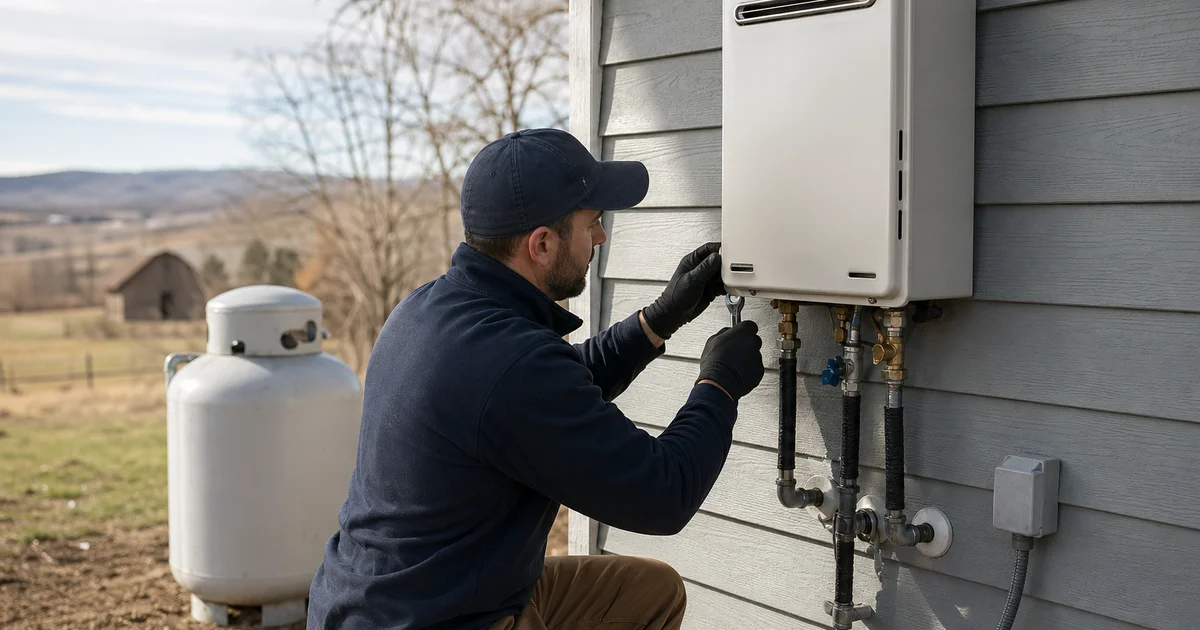
We often see property owners struggle with the choice between propane and natural gas water heating. Natural gas tankless is the default for most US homes with service at the curb.
Propane tankless is the right answer for rural homes without gas service.
Our team knows this decision requires looking closely at your specific property. From what I have seen, the right choice depends heavily on your local utility access.
Let’s compare propane vs natural gas tankless models to see which scenario applies and what the trade-offs look like.
When to Choose Propane
Propane tankless is the right choice when you have no natural gas service at the curb and utility connection costs are prohibitive. It also makes sense if you have existing propane infrastructure for other appliances like a range, dryer, or generator.
We recommend sticking with propane in deep rural areas or remote regions like the Pacific Northwest. Trenching a new natural gas line costs between $15 and $50 per linear foot. This installation fee makes a new gas line extremely expensive for long driveways. Our technicians usually advise against trenching if your home is set far back from the road.
Outside those specific cases, natural gas wins on operating cost and refill logistics. Here is exactly when you should stick with liquid petroleum:
- No natural gas service at the curb: The utility connection cost is simply prohibitive.
- Existing propane infrastructure: You already run a range, dryer, or generator on an LP tankless water heater setup.
- Remote off-grid locations: You live in an area where delivery trucks are your only reliable fuel option.
Operating Cost Reality
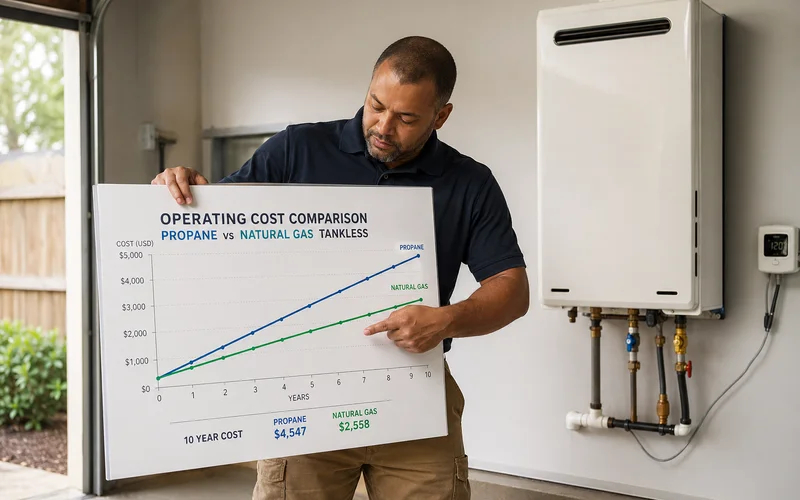
Natural gas provides significant savings, as propane runs roughly double the operating cost of natural gas per BTU. For a typical household using $20 to $30 a month in natural gas water heating, the propane equivalent is $50 to $80 a month.
We track these fuel rates closely to give you accurate estimates. The US Energy Information Administration reported in early 2026 that residential propane averages around $2.75 per gallon nationwide. Natural gas costs average about $1.45 per therm, according to recent Constellation Energy data. Our breakdown shows exactly how these 2026 figures translate into real expenses.
| Fuel | Typical Cost (US Avg) | BTU per Unit | Cost per 100K BTU |
|---|---|---|---|
| Natural gas | $1.45/therm | 100,000 per therm | $1.45 |
| Propane | $2.75/gallon | 91,500 per gallon | $3.00 |
You will notice a stark difference in the monthly budget. This price gap is why many homeowners save 30 to 40 percent on fuel bills after making a propane tankless conversion to natural gas.
BTU Output Differences
Propane is denser per cubic foot than natural gas, which means propane tankless units typically deliver slightly higher peak BTU output for the same physical unit size. For sizing purposes, the Gallons Per Minute (GPM) rating is what actually matters.
We always advise buyers to check the GPM rating first. This high density allows propane to burn very hot, but it does not change the physical water output.
| Fuel Type | Energy Density | Impact on Hot Water Flow |
|---|---|---|
| Natural Gas | 1,036 BTUs per cubic foot | None (Determined by GPM) |
| Propane | 2,516 BTUs per cubic foot | None (Determined by GPM) |
Our preferred major brands sell parallel propane and natural gas SKUs with identical GPM ratings. You will get the same hot water flow regardless of the fuel type. A popular model like the Rinnai RU199i delivers 11 GPM whether you run it on natural gas or liquid petroleum.
Unit Compatibility
Most major brands offer either dedicated propane SKUs configured at the factory or dual-fuel units with a field conversion kit. You must never run a unit on the wrong fuel without the proper kit. Incorrect combustion will damage the unit and void the warranty.
We see amazing innovations in unit compatibility right now. Rinnai recently introduced SENSEI RX models with Adaptive Gas Valve Technology that adjusts automatically to either fuel type without needing a physical kit. Older models and other brands like Navien still require a manual change. Our installers often use a manufacturer-approved kit, like the Navien AS-19, which costs about $110.
Conversion Kit Requirements
Field conversion requires strict attention to detail and professional labor. A licensed plumber must perform these exact steps to ensure safety:
- Install the manufacturer-approved hardware kit.
- Swap the gas orifice and adjust the system dip switches.
- Perform a complete combustion analysis after the install.
Tank and Refill Logistics
Propane requires you to manage a regular refill schedule, an auto-refill service, and an above-ground or underground storage tank. Most homes require fresh fuel deliveries two to four times per year.
We know that tank logistics add a layer of maintenance to your property. Tank rental or purchase ranges from $400 to $1,500 for above-ground models. A larger 500-gallon underground tank installation runs between $1,500 and $5,500, according to 2026 construction data.
Our team recommends underground tanks if you want to preserve your landscaping. Refill costs depend heavily on regional propane pricing and seasonal winter demand. You need to plan for these deliveries to avoid running out of hot water.
When Both Are Available
If natural gas is at the curb, choose natural gas. You get lower operating costs, no tank logistics, and no refill scheduling to worry about.
We strongly advise switching to natural gas if the option exists. The advantages of making the switch are clear:
- Zero delivery scheduling: The fuel comes straight from the municipal line.
- Price stability: Natural gas avoids the sharp winter price spikes common with delivered fuels.
- Higher property appeal: Nearly 45 percent of US homes now rely on natural gas as their primary heating fuel.
Our analysts note that the only argument for propane in a natural-gas-available home is matching existing propane infrastructure. Even then, switching the water heater to natural gas is almost always the right financial call.
Natural gas provides an uninterrupted supply, directly from the utility. For the broader fuel decision including electric models, see our electric to gas tankless conversion guide. Our installation service sizes both gas and propane options during the virtual estimate.
Conclusion
We hope this comparison clears up the confusion around your water heating options. Selecting the right fuel source comes down to your local utility access and long-term budget goals. Start by checking your street for existing utility lines, and then contact a local professional to quote the final installation.
Frequently Asked Questions
Is propane tankless cheaper to operate than natural gas?
Can a natural gas tankless run on propane?
How big a propane tank do I need?
Related Guides
Condensing vs Non-Condensing Tankless: Which Is Right?
Condensing tankless units run 90%+ efficient with cheap PVC venting; non-condensing are 80-85% with stainless flue. Total-cost-of-ownership math inside.
Electric to Gas Tankless Conversion (Cost & Process)
Electric-to-gas conversions are the most expensive scenario — typically adding $1K-$2K. Why it still pencils out, what's involved, and propane as an alternative.
Gas Line Requirements for Tankless Water Heater Installation
Tankless units need a 3/4 inch gas line in most cases — your existing 1/2 inch line probably won't work. Here's how to know if you need an upgrade and what it costs.
How to Choose a Tankless Water Heater Installer
Questions to ask, red flags to avoid, and certifications that matter when picking a tankless installer. Why the cheapest quote is usually a warning.