
How to Choose a Tankless Water Heater Installer
Questions to ask, red flags to avoid, and certifications that matter when picking a tankless installer. Why the cheapest quote is usually a warning.
7 min read

We see homeowners obsess over water heater brands every single day. The reality is that a highly skilled professional installing a mid-tier unit will consistently outperform a mediocre plumber forcing in a premium model.
Our data from 2026 shows the average tankless installation now costs around $2,637. The important distinction most people miss here is that the bulk of that cost comes from complex gas line and venting upgrades.
Learning how to choose a tankless installer is the single most important step in protecting that investment.
Let’s look at the actual qualifications you need to verify, the red flags that ruin warranties, and a clear method for evaluating bids.
What Separates a Specialist From a General Plumber
Tankless installation is a distinct mechanical discipline. The professional who completes 50 conversions a year will deliver a vastly superior result compared to a general contractor who only does five.
We constantly check for brand-specific certifications during our network audits. Programs like the Navien Service Specialist require technicians to pass advanced training and carry a minimum of $1,000,000 in liability insurance. General plumbers simply do not invest that kind of time or money for a once-a-year job.
Our standard is that a proper installer must carry a combustion analyzer on their truck. This specific diagnostic tool costs hundreds of dollars and calibrates the gas-to-oxygen mixture precisely. Relying on guesswork instead of a calibrated tool often leads to inefficient burns and shortened unit life spans.
A great tankless plumber near me should possess specific, verifiable qualifications. Look for these non-negotiable items:
- Manufacturer Service Programs: True pros hold active titles like Navien Service Specialist or Rinnai Level-3 Certified.
- Proof of Volume: Always ask how many conversions they completed in the last 12 months.
- Diagnostic Equipment: The truck must have a combustion analyzer to dial in the exact gas ratio.
- Dedicated Insurance: Specialized programs require a million-dollar liability policy specifically naming the manufacturer.
- Stocked OEM Parts: They should carry brand-specific ignition boards and valves rather than generic replacements.
We also verify that the technician has original equipment manufacturer parts readily available. Having immediate access to brand-specific components prevents you from waiting weeks for a simple repair. The difference between a specialist and a generalist shows up plainly in unit longevity, warranty validity, and avoided service calls.
Questions to Ask Before You Sign
Asking the right questions filters out unqualified contractors immediately. Five specific inquiries will reveal whether you have found a reliable professional for your home.
We advise clients to demand fully itemized quotes rather than accepting a single number. A lump-sum bid intentionally hides critical upgrades that might be missing from the scope of work. Upgrading a standard half-inch gas line to a three-quarter-inch pipe typically adds $500 to $1,000 to a 2026 installation.
Our contractors always separate the unit price from venting and labor. Dedicated stainless-steel venting routed directly to the exterior usually costs another $300 to $600. Failing to separate these line items makes comparing competing bids impossible.
Use these five questions to filter out the wrong installers fast:
- “Could you itemize the exact line items on this quote?” Real professionals separate the unit, labor, gas line modifications, permits, and condensate drain work.
- “Who is filing the municipal permits?” The right answer is that they handle all permitting. Any contractor who suggests skipping this step is committing a code violation.
- “Which specific manufacturer certifications do you hold?” Verify they are authorized by the exact brand you intend to purchase.
- “Will you perform a combustion analysis upon commissioning?” A true pro will say yes and provide a physical printout of the results.
- “How do you handle warranty claims in year five?” The correct response involves the installer coordinating the labor and parts claim directly with the manufacturer.
Red Flags
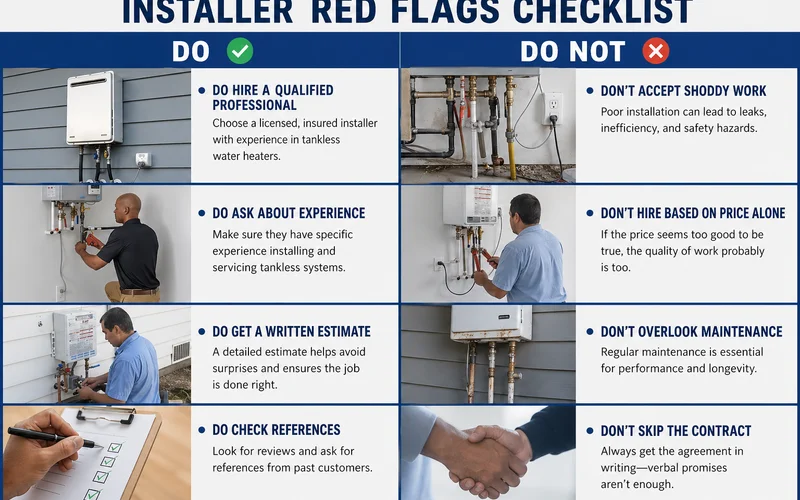
Certain warning signs should make you walk away from a bid entirely. Recognizing these red flags protects your property from severe water damage and safety hazards.
We tell homeowners to be extremely cautious of bids that sit thousands of dollars below the local average. The national average labor rate for a licensed plumber in 2026 ranges from $100 to $125 per hour. If a quote implies a much lower rate, the contractor is likely using unlicensed apprentices.
Our technical team frequently sees warranties voided due to fundamental installation errors. Manufacturers like Eccotemp clearly dictate that venting must slope downward to allow condensation to drain away. An amateur pushing an upward slope will cause water to pool inside the electrical components.
Walk away immediately when you see these warning signs:
- Drastically Underpriced Bids: Low costs often indicate undersized gas lines or reused old venting.
- No Itemized Invoice: A lump-sum total makes it impossible to know what you are actually buying.
- Missing Labor Warranty: The industry standard for reputable companies is at least a one-year guarantee on their work.
- Code Violations: Placing units too close to windows or failing to slope vents correctly creates major safety risks.
- High-Pressure Tactics: In-home pitches demanding a same-day signature usually mask inflated pricing.
We strongly suggest asking for insurance paperwork before any work begins. A professional will happily provide their documentation upon request. Anyone who hesitates or refuses is not worth the risk.
Why Buying the Unit Yourself Backfires
Sourcing a unit from a big-box store to save money almost always results in higher total costs. The minimal retail savings disappear the moment you hire labor to install a customer-supplied machine.
We constantly see homeowners attempt to buy a unit directly from an online retailer. Plumbers rely on equipment margins to help cover their operational overhead. When you supply the hardware, most local professionals simply raise their hourly labor rates to recover that exact amount.
Our research indicates these inflated labor fees frequently exceed any discount you found online. Warranty enforcement also becomes a massive headache when the installer did not supply the equipment. Manufacturers typically deny claims if an unauthorized third party provided the unit.
Review this simple comparison to understand the true financial impact:
| Sourcing Method | Labor Rates | Warranty Status | Sizing Risk |
|---|---|---|---|
| Buying Through Installer | Standard ($100-$125/hr) | Fully protected and coordinated | Zero risk |
| Buying the Unit Yourself | Inflated to cover lost margin | Frequently voided by manufacturer | High risk of buying wrong GPM |
We highly recommend letting the licensed professional handle the equipment purchase. Buying the exact right size is a major hurdle for the average consumer. You might accidentally purchase a 9 Gallon Per Minute unit when your household actually requires an 11 GPM model. Paying the standard markup ensures clean warranty pathways and guarantees the correct sizing.
Why a Vetted Network Matters
The skill gap between a true specialist and a standard handyman is massive in the water heating industry. Total Tankless built a dedicated network to protect property owners from poor workmanship and voided warranties.
We created our program because finding a vetted tankless plumber on your own requires dozens of phone calls. Every single technician in our system must meet strict, non-negotiable criteria. This baseline ensures your project is handled safely and legally.
Our vetting process requires that all network partners hold an active state plumbing license and gas-fitting certification. They must also demonstrate specific manufacturer training across at least three of the six major brands. A minimum volume of 50 installations per year is required to stay active.
Every installer in our network meets these strict standards:
- Active state plumbing license and valid gas-fitting certification.
- Manufacturer training across at least three major appliance brands.
- Minimum tankless install volume of 50 units per year.
- Combustion analysis tooling present on every dispatch truck.
- Current insurance documentation filed directly with our office.
- A firm commitment to handling all warranty coordination.
We audit these credentials on a rolling basis. Partners drop off immediately if their quality metrics slip. For the cost reality you should expect from a real install, see our installation cost breakdown. When you’re ready to be matched with the best tankless installer in your area, our installation service starts with a free virtual estimate. Understanding how to choose a tankless installer guarantees your home receives reliable hot water for decades. Take the first step in your upgrade by scheduling your consultation today.
Frequently Asked Questions
Should I buy the tankless unit myself from Home Depot?
What certifications should I look for?
How many quotes should I get?
Related Guides
Condensing vs Non-Condensing Tankless: Which Is Right?
Condensing tankless units run 90%+ efficient with cheap PVC venting; non-condensing are 80-85% with stainless flue. Total-cost-of-ownership math inside.
Electric to Gas Tankless Conversion (Cost & Process)
Electric-to-gas conversions are the most expensive scenario — typically adding $1K-$2K. Why it still pencils out, what's involved, and propane as an alternative.
Gas Line Requirements for Tankless Water Heater Installation
Tankless units need a 3/4 inch gas line in most cases — your existing 1/2 inch line probably won't work. Here's how to know if you need an upgrade and what it costs.
Propane vs Natural Gas Tankless Water Heater Comparison
When to choose propane (no natural gas line available), how operating costs compare, BTU output differences, and unit compatibility for both fuels.