
How Does a Tankless Water Heater Work?
Plain-English explanation of tankless water heater technology — on-demand heating, modulating burners, GPM ratings, and why there's no standby energy loss.
7 min read
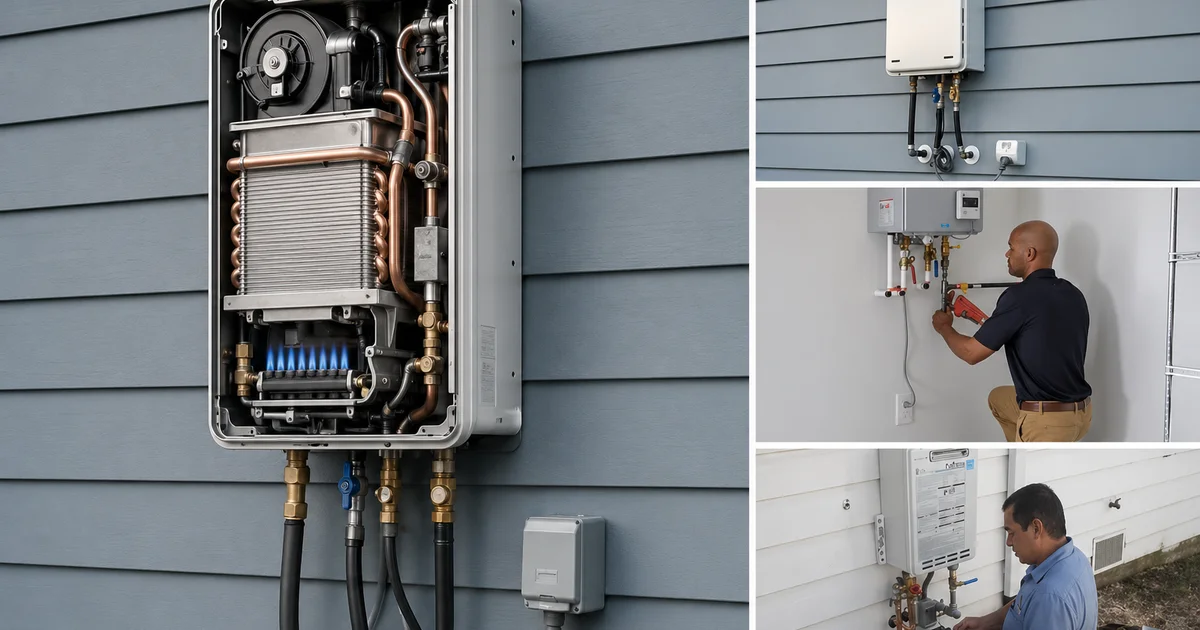
Our team sees the same frustration every day across residential and commercial properties. People are tired of paying to keep 50 gallons of water hot when nobody is in the building.
We know that switching to an on-demand system solves this fundamental flaw. A tankless water heater heats water only when you open a tap.
Our goal is to help you understand how this single design choice completely changes plumbing efficiency. Clients frequently ask us, how does a tankless water heater work?
We will review the internal components, compare fuel types, and detail exactly how tankless works. This straightforward guide leaves no feature of the tankless water heater explained vaguely.
The Core Concept
A flow sensor acts as the primary trigger for the entire system. We always start by explaining that this sensor holds the direct answer to how does a tankless water heater work.
A typical modern model requires a minimum flow rate of 0.5 GPM to activate. Our technicians then watch the control board trigger a high-BTU burner or electric elements.
The internal heat exchanger warms the water to your exact set temperature in seconds. We strongly recommend following Department of Energy guidelines and setting the output to 120 degrees Fahrenheit.
Hot water exits the unit and flows to your fixture continuously. Our favorite feature is that the process stops instantly when you turn off the tap.
The system shuts down completely, meaning no reheating or standby energy waste occurs.
The Heating Sequence
Our installation crews explain the tankless heating cycle in four simple steps.
- First, opening a fixture pulls cold water into the system.
- We then rely on the flow sensor to read the water demand.
- Next, the control board ignites the burner immediately.
- Our final step involves the delivery of endless hot water until the tap closes.
This direct approach eliminates the need for a massive storage tank.
The Three Main Components
Every on-demand water heater relies on three primary internal parts to function. We frequently install units like the Navien NPE-240A2 because they use high-quality versions of these components.
- Heat Exchanger: The primary heat exchanger is where the actual heating happens. We prefer modern condensing units that feature dual stainless steel heat exchangers.
- Modulating Burner: This component adjusts the gas flow continuously to match your real-time hot water demand. Our testing shows that a low-flow sink runs the burner at low fire, while multiple showers demand maximum BTU output.
- Flow Sensor and Control Board: These complex electronics detect water movement and manage the exact temperature output. We love that modern boards also handle error detection, diagnostic codes, and built-in recirculation pump control.
High-quality components reduce maintenance calls and extend the lifespan of the equipment.
Gas vs Electric Tankless
We help property owners choose between gas and electric units every single week. The right choice depends entirely on your home utility setup and local climate.
Gas Tankless Requirements
Our team installs gas models most frequently in US homes with existing natural gas service. These units use a high-BTU burner, typically ranging from 150,000 to 199,000 BTU per hour.
We check for several specific site requirements before installing a gas system. A standard property needs a three-quarter-inch gas line with adequate pressure.
Our crews also install dedicated combustion air supply lines and proper venting. Condensing units require PVC venting, while non-condensing units need stainless steel exhaust pipes.
Electric Tankless Requirements
We see electric tankless models as a great option for smaller spaces or warmer climates. High-amperage heating elements provide the power instead of combustible fuel.
Our electricians warn clients that whole-house electric units require massive electrical capacity. A standard US home often needs a minimum of 120 to 160 amps of dedicated electrical service.
We frequently coordinate 200-amp or 400-amp panel upgrades for older properties during these installations. A heavy-up panel upgrade easily adds between $1,800 and $4,500 to the total installation cost.
Our clients appreciate that electric models do not require combustion air, venting, or gas lines. The visual breakdown below compares the key requirements for both fuel types.
| Feature | Gas Tankless Requirements | Electric Tankless Requirements |
|---|---|---|
| Power Needs | Minimal electrical (120V) | Massive capacity (120-160 dedicated Amps) |
| Panel Upgrade | Rarely needed | Often required ($1,800 - $4,500 cost) |
| Venting Needs | PVC or Stainless Steel | None required |
| Best Climate | Excellent for cold climates | Better suited for warm climates |
We suggest reviewing these differences with a qualified local contractor.
Why No Standby Loss
Standby loss acts as a hidden tax on your monthly utility bills. We see traditional 50-gallon tanks wasting energy 24 hours a day.
Up to 15 percent of a conventional tank’s total energy use goes solely toward keeping unused water hot. Our energy audits prove that eliminating this continuous drain saves significant money.
“Zero water flow means zero burner firing, which completely eliminates standby energy loss.”
A tankless unit heats water only when a specific demand exists at the tap. We love that zero water flow means the burner stays off entirely.
This single difference completely eliminates standby energy loss. Our team tracks Department of Energy data to verify these real-world performance claims.
Official Energy Star ratings credit gas tankless models with a 24 to 34 percent efficiency advantage over standard gas tanks. We find that this efficiency bump translates to an average savings of $108 per year for a typical US household.
The financial return becomes very clear over a twenty-year equipment lifespan.
GPM and Why Sizing Matters
We consider accurate sizing to be the most critical step of any installation. GPM, or gallons per minute, represents the total flow capacity of your water heater.
Our technicians know that a 9 GPM tankless unit delivers 9 gallons of hot water per minute continuously under ideal conditions. Two standard showers at 2.5 GPM each, plus a kitchen sink at 1.5 GPM, requires a total flow of 6.5 GPM.
We outline exactly how to map out these fixture flow rates in our tankless sizing guide. Local climate actually dictates the final performance limits of your system.
The Groundwater Temperature Factor
Our crews always factor incoming groundwater temperatures into capacity calculations. The temperature rise is the strict difference between your cold incoming groundwater and the desired 120-degree output.
We know that homes in Boston face incoming winter water temperatures around 42 degrees Fahrenheit. Heating 42-degree water up to a safe 120 degrees requires a massive 78-degree temperature rise.
Our testing shows that this heavy workload eats into the total flow capacity, causing a 9 GPM unit to deliver only 5 or 6 GPM. A home in Miami starts with 72-degree groundwater, requiring much less heating energy.
We see warm-climate units reach their maximum flow ratings with absolute ease. This geographic temperature comparison highlights the drastic difference in heating demands.
| City | Winter Groundwater | Target Output | Required Temp Rise | Capacity Impact |
|---|---|---|---|---|
| Miami, FL | ~72°F | 120°F | 48°F | Minimal flow loss |
| Boston, MA | ~42°F | 120°F | 78°F | Significant flow loss |
We recommend checking local groundwater maps before selecting a specific model size.
The Practical Bottom Line
The upfront installation cost represents the biggest hurdle for most property owners. We always remind clients that tankless technology pays dividends over the long haul.
These systems deliver continuous hot water, lower monthly energy bills, and a superior lifespan. Our installation records highlight the dramatic difference in equipment longevity.
- Standard tank water heaters typically fail and require total replacement after just 8 to 12 years.
- We routinely see tankless units operate efficiently for 15 to 20 years with basic maintenance.
Millions of US homes rely on on-demand heating systems every single day. We fully trust this mature, well-understood technology after executing hundreds of successful installations.
Upgrading your plumbing is a major financial decision. We encourage you to review the head-to-head financial trade-offs in our complete tank vs tankless comparison.
Understanding the answer to ‘how does a tankless water heater work’ ensures you make the best long-term investment. Our team recommends evaluating your peak household demand as the ideal next step.
Frequently Asked Questions
How does a tankless heat water so quickly?
Do tankless units use more electricity?
What is GPM and why does it matter?
Related Guides
Are Tankless Water Heaters Worth It? An Honest 2026 Breakdown
An honest breakdown of when tankless pays off and when it doesn't. Continuous hot water, 20+ year lifespan, real upfront costs, and the homeowner profiles where it makes sense.
Best Tankless Water Heater Brands Compared (2026)
Brand-neutral comparison of Rinnai, Navien, Noritz, Rheem, Bosch, and AO Smith tankless water heaters. GPM ranges, warranties, where each excels.
How Long Do Tankless Water Heaters Last? (Real Numbers)
Tankless water heaters last 20+ years with proper care, but skipped maintenance can cut that in half. Real lifespan numbers, key longevity factors, and brand warranty terms.
Tank vs Tankless Water Heater: 2026 Head-to-Head Comparison
Direct comparison of tank vs tankless water heaters: cost, lifespan, space, efficiency, hot-water capacity. Decision matrix to find the right fit for your home.