
How Long Do Tankless Water Heaters Last?
Tankless water heaters last 20+ years with proper care, but skipped maintenance can cut that in half. Real lifespan numbers, key longevity factors, and brand warranty terms.
6 min read
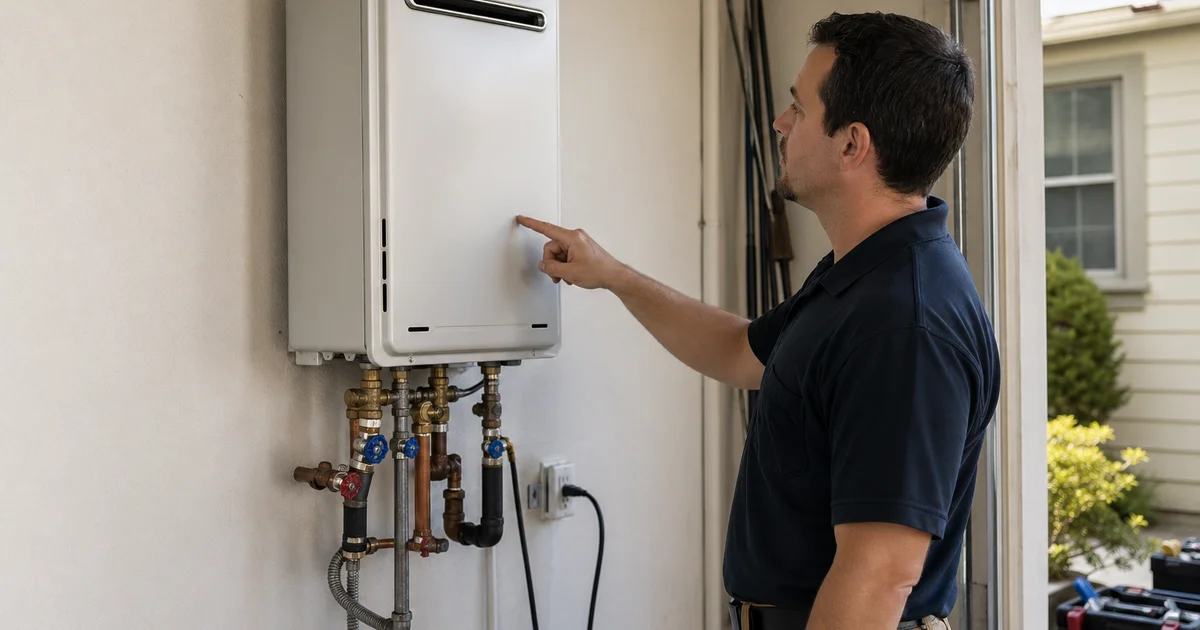
Upgrading to a tankless system is a big upfront investment, typically running between $2,600 and $5,500 across the US according to 2026 industry pricing data. When property owners ask us how long do tankless water heaters last, we explain that the expected longevity usually justifies that initial cost.
A 20-year lifespan sounds fantastic on paper.
Getting there requires treating the equipment like a high-performance engine rather than a forgotten box in the basement. We see the real-world results when maintenance is ignored, and the damage happens surprisingly fast. Let’s look at the actual data behind these lifespans and outline exactly what you need to do to protect your investment.
How Long Do Tankless Water Heaters Last? What “20+ Years” Actually Means
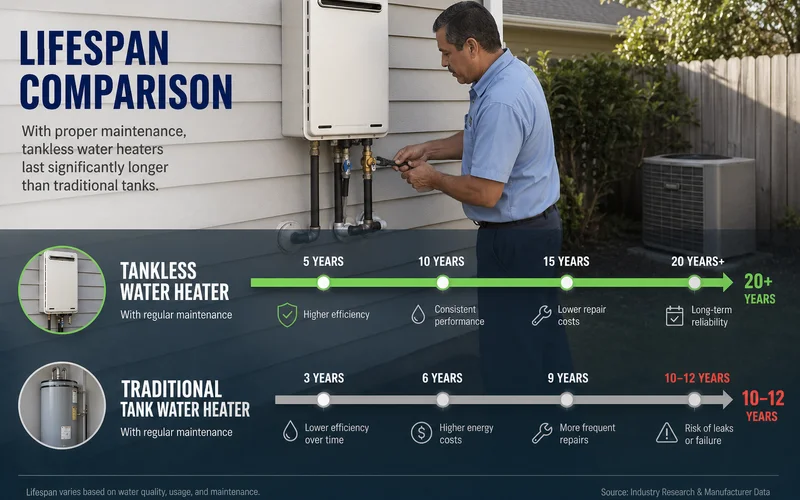
A tankless water heater is engineered to last 20 to 25 years. We typically see systems hit that mark only when they receive regular upkeep and are correctly sized for the property. The US Department of Energy confirms this two-decade expectancy, which is a massive upgrade over the 8 to 12 years you get from a traditional storage tank.
Achieving this maximum tankless water heater life expectancy depends entirely on the installation and operating conditions. We have identified four non-negotiable factors that determine if your unit survives two decades. Missing even one of these requirements will cause degradation patterns to appear much earlier.
The Four Pillars of Longevity
- Routine Water Treatment: Annual maintenance is required, but you must increase this to every 6 months in states with heavy mineral content.
- Accurate GPM Sizing: Sizing your unit correctly for your household’s Gallons Per Minute demand prevents overworking the burner. (ENERGY STAR notes a standard shower uses 2.5 GPM, while a dishwasher needs 1.3 GPM).
- Professional Installation: A quality setup includes proper venting, adequate gas-line capacity (often requiring a 3/4-inch pipe upgrade), and strict combustion analysis.
- Consistent Activity: Long stretches of inactivity in vacant homes can allow water to freeze, which will easily crack the internal heat exchanger.
What Shortens Tankless Lifespan
Scale buildup from hard water is the leading cause of a shortened tankless water heater lifespan. We often replace units years before their time simply because the owner skipped basic descaling. According to a Water Quality Research Foundation study, an unprotected tankless heater operating in a hard water area can fail in just 1.6 years.
That statistic is alarming for property owners, considering roughly 85 percent of the country has hard water. We highly recommend taking action before scale permanently restricts your water flow.
Five Common Lifespan Killers
- Untreated Hard Water: Calcium scale fouls the heat exchanger and acts as a barrier. Just one-eighth of an inch of scale drops the system’s energy efficiency by up to 30 percent.
- Undersized Equipment: Running a unit at peak modulation constantly to keep up with demand wears the internal burner much faster.
- Restricted Venting: Blocked or undersized exhaust vents cause incomplete combustion, which fouls the heat exchanger with soot.
- Ignored Safety Checks: Gas units that drift out of their proper fuel-to-air balance will slowly burn themselves out.
- Amateur Installation: Initial plumbing and gas errors compound over the years, leading to leaks and pressure issues.
Most of these problems are completely preventable. We suggest booking a real annual maintenance visit instead of relying on a basic 15-minute vinegar flush. A thorough checkup includes inspecting the sensors and cleaning the air intake filter.
Brand Warranty Reality
Manufacturer warranties cover the primary heat exchanger for 10 to 25 years, but this coverage strictly requires documented proof of regular maintenance. We always warn customers that losing your service records often means losing your coverage when you need it most.
Major manufacturers like Noritz, Navien, and Rinnai include fine print demanding annual descaling by a licensed professional. We have seen claims denied by brands simply because a homeowner could not produce a receipt for a system flush. Buying your equipment from an unauthorized internet dealer is another common pitfall that instantly voids your protection.
Manufacturer Coverage Comparison
| Brand | Heat Exchanger | Parts | Labor |
|---|---|---|---|
| Noritz | 12 - 25 years | 5 years | 1 year |
| Navien | 15 years | 5 years | 1 year |
| Rinnai | 15 years | 5 years | 1 year |
| Rheem | 12 years | 5 years | 1 year |
| AO Smith | 12 years | 5 years | 1 year |
| Bosch | 10 - 15 years | 5 years | 1 year |
There are proactive steps you can take to maximize these guarantees. We advise registering your new unit immediately after installation. Rinnai, for example, extends its standard 1-year labor coverage out to 5 full years if you register the product within 90 days. The Noritz EZ series offers an impressive 25-year heat exchanger warranty, but only if you actively manage your water quality.
Signs You’re Approaching End of Life
You will know your unit is reaching the end of its life when error codes recur frequently and hot water flow noticeably drops. We usually see these final symptoms appear around the 12 to 15-year mark if routine care was previously neglected.
Paying attention to the control panel is your best defense against an unexpected cold shower. We recommend keeping the user manual nearby so you can quickly identify the exact fault. For instance, a Rinnai Code 11 indicates severe ignition issues, while a Navien E032 points to a dangerous exhaust blockage.
Key Indicators for Replacement
- Persistent Error Codes: Faults that immediately return after you perform a power-cycle reset.
- Noticeable Flow Reduction: Weak water pressure at the tap even after completing a fresh chemical descaling.
- Temperature Inconsistencies: Output temperatures that drift unpredictably and refuse to hold calibration.
- External Discoloration: Visible scale staining or rust at the cold water inlet and hot water outlet fittings.
- Failing Diagnostics: Combustion test results that consistently trend out of safe specifications during annual visits.
When two or more of these symptoms appear together, it is time to start budgeting for a new installation. We generally apply the 50 percent rule for older units. If a major repair costs more than half the price of a total replacement, replacing the whole system makes the most financial sense. National average replacement costs in 2026 sit around $3,500, so avoiding premature failure is highly lucrative.
Our repair vs replacement guide walks through this specific financial threshold case-by-case. If you are still wondering how long do tankless water heaters last, the answer depends entirely on your maintenance habits. If you want your unit to actually hit the 20-year milestone, scheduling a professional descaling service is the single highest-impact investment you can make.
Frequently Asked Questions
Does hard water shorten tankless lifespan?
What's the longest a tankless can realistically last?
What manufacturer warranties cover lifespan?
Related Guides
Are Tankless Water Heaters Worth It? An Honest 2026 Breakdown
An honest breakdown of when tankless pays off and when it doesn't. Continuous hot water, 20+ year lifespan, real upfront costs, and the homeowner profiles where it makes sense.
Best Tankless Water Heater Brands Compared (2026)
Brand-neutral comparison of Rinnai, Navien, Noritz, Rheem, Bosch, and AO Smith tankless water heaters. GPM ranges, warranties, where each excels.
How Does a Tankless Water Heater Work? (Beginner-Friendly)
Plain-English explanation of tankless water heater technology — on-demand heating, modulating burners, GPM ratings, and why there's no standby energy loss.
Tank vs Tankless Water Heater: 2026 Head-to-Head Comparison
Direct comparison of tank vs tankless water heaters: cost, lifespan, space, efficiency, hot-water capacity. Decision matrix to find the right fit for your home.