
Tankless Repair vs Replacement
When to fix vs replace a tankless: the 50% rule, age threshold, failure modes that always mean replacement. Honest decision framework with examples.
7 min read
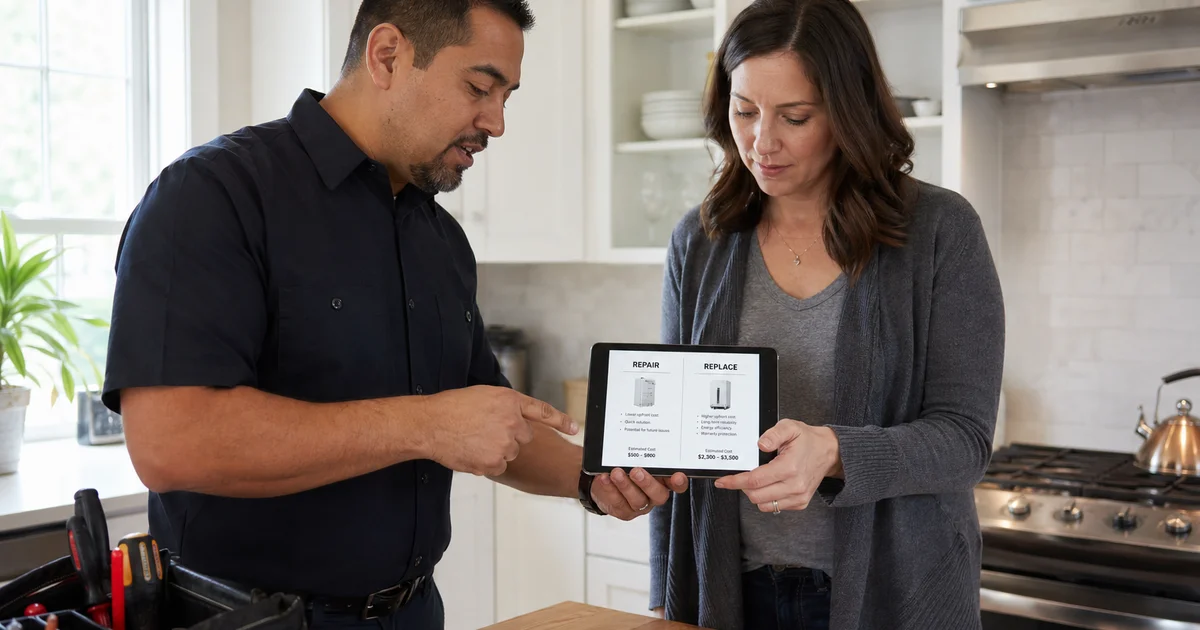
We see dozens of failing water heating systems every week across the US. Making the choice between tankless repair vs replacement usually comes down to three deciding factors: age, repair cost, and warranty status.
This guide provides the exact financial framework our field technicians use every day.
Making the wrong call here can cost you thousands in wasted labor and repeated breakdowns. Let’s look at the actual numbers and thresholds that should drive your decision.
The 50% Rule
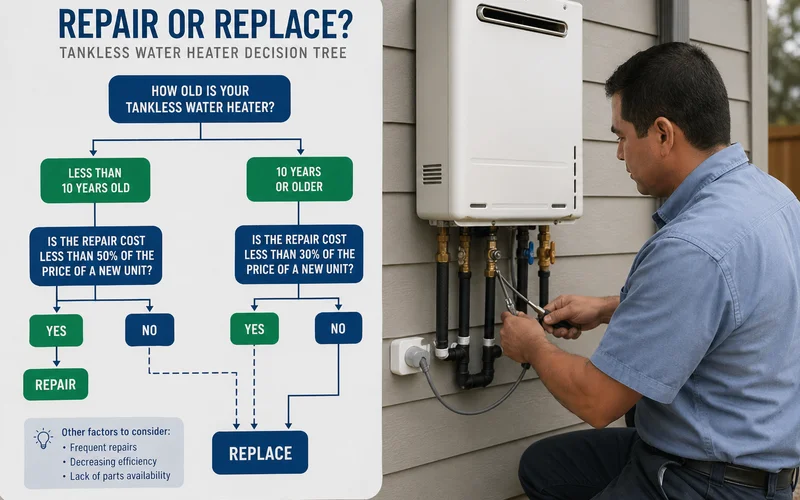
If you are asking yourself, should I repair or replace tankless equipment, the quickest way to decide is by applying the 50% rule. If a single major fix costs more than half the price of a brand-new installation, replacement is the better financial choice.
Our team relies on this threshold because sinking massive funds into an aging unit rarely pays off. New tankless installations in the US typically run between $3,000 and $5,500 depending on the model and regional labor rates.
That puts your 50% threshold right at $1,500 to $2,750. Surpassing this limit usually happens with catastrophic component failures.
Repairs That Usually Trigger the 50% Rule
- Heat exchanger replacement (parts and labor easily exceed $1,500)
- Control board failures on units older than 10 years
- Multiple simultaneous sensor and gas valve failures
We always remind customers that replacing the unit entirely resets your clock. A fresh installation typically comes with a new 15-year manufacturer warranty on the primary heat exchanger.
Age Thresholds
Unit age is the second most critical factor when evaluating your ideal tankless replacement age. The older the system gets, the more non-linear the component degradation becomes.
Our technicians follow a strict age-based matrix when advising local property owners.
| Unit Age | Default Recommendation |
|---|---|
| Under 8 years | Repair almost always |
| 8-12 years | Case-by-case using 50% rule |
| 12-15 years | Lean toward replacement on major repairs |
| 15+ years | Replace unless repair is under $300 |
Age matters deeply because components wear out at different rates depending on local water quality. According to the US Geological Survey, 85% of American homes have hard water.
This mineral buildup accelerates wear and tear on internal piping. A 12-year-old system with a sudden flow sensor failure is highly likely to need an expensive control board replacement within the next two years.
Bundling those inevitable failures into a single new unit purchase beats paying for multiple emergency service calls.
Failure Modes That Almost Always Mean Replacement
Certain catastrophic failures mean you should upgrade the unit regardless of its exact age. These specific breakdown scenarios signal the end of a unit’s functional, safe lifespan.
We strongly advise against repairing a cracked heat exchanger that shows visible scale damage. The underlying calcium buildup persists even after the new metal is installed.
The 5 Dealbreaker Scenarios
- Heat exchanger crack with visible scale damage: The root cause of the fracture will simply destroy the new replacement part.
- Multiple simultaneous component failures: This indicates broader, systemic degradation throughout the entire casing.
- Control board failure on older units: Replacing a main circuit board on a 12-year-old system typically costs $400 to $750 in parts and labor.
- Repeated combustion safety issues: Gas appliance safety is never something you can gamble on with cheap maintenance.
- Manufacturer-discontinued models: Finding specific parts for an obsolete unit becomes nearly impossible and highly expensive within a few short years.
When Repair Is Almost Always Right
Minor component failures on newer units mean a simple repair is almost always the correct path. Throwing away an efficient system for a routine wear-and-tear issue is incredibly wasteful.
Our field data shows that many common service calls can be resolved for well under $400.
Common Routine Fixes
- Inlet filter or flow sensor failure: This is an easy $150 to $350 fix that fully restores operation.
- Ignitor or flame sensor wear: These common wear parts typically cost $200 to $400 to swap out on units under 10 years old.
- Pressure relief valve drip: A standard plumber can resolve this simple component swap for $100 to $200.
These are routine maintenance items that act just like brake pads on a vehicle. Replacing the entire water heater for these minor issues makes zero financial sense.
Warranty Status Considerations
Checking your active warranties is the final step in the repair versus replacement calculation. A valid warranty can shift a massive repair bill down to just a few hundred dollars in hourly labor costs.
Our team always checks the original manufacturer documentation before quoting a major fix. For example, popular residential models from brands like Rinnai and Navien often carry a 15-year warranty on the heat exchanger.
Evaluating Your Coverage Options
- Manufacturer heat exchanger warranty still valid? Repair is often dramatically cheaper than replacement because the manufacturer covers the expensive part, and you pay labor only.
- Labor warranty still valid? You face the exact same advantage with a covered repair versus a totally new install cost.
- Both warranties expired? You must firmly apply the 50% rule based on the current age and quoted repair cost.
- Manufacturer warranty voided due to skipped maintenance? This is the absolute worst-case scenario.
You are paying full retail cost for a major repair on an aging unit. Starting over with a brand new replacement usually makes more financial sense here. Just be sure to reset your annual maintenance discipline this time around.
Cost Comparison Examples
Real-world numbers make this decision process much easier to understand. Here are three exact scenarios based on typical US plumbing service quotes.
Our technicians run these exact calculations before making a final recommendation to any customer.
Scenario 1: Easy Repair
Example: Rinnai NPE-A2 (Age: 7 years)
- Issue: Control board failure ($550 quoted)
- Replacement cost: $4,500
- Repair as % of replacement: 12%
- Decision: Repair. This is an easy call for a relatively young unit.
Scenario 2: The Borderline Case
Example: Navien NPE-240A2 (Age: 13 years)
- Issue: Heat exchanger crack ($1,200 part + $450 labor = $1,650)
- Replacement cost: $4,800
- Repair as % of replacement: 34%
- Decision: Borderline. We lean toward replacement because the advanced age and metal cracking indicate broader systemic degradation.
Scenario 3: Clear Replacement
Example: Noritz Unit (Age: 16 years)
- Issue: Multiple cascading failures totaling $2,100
- Replacement cost: $4,200
- Repair as % of replacement: 50%
- Decision: Replace. The quote crosses the 50% line, and the extreme age severely compounds the bad math.
Review our detailed tankless repair cost guide to see comprehensive component pricing.
When the math clearly points toward starting fresh, our dedicated installation service handles the entire swap with full warranty coordination. Checking these numbers today will save you from making a costly mistake tomorrow.
Frequently Asked Questions
What's the 50% rule for tankless replacement?
Is a heat exchanger replacement worth it?
Should I replace if my warranty is expired?
Related Guides
Cold Water Sandwich Problem in Tankless Water Heaters
What causes the 'cold water sandwich' tankless quirk — and why it's normal, not a defect. Recirculation pumps and mini-tank buffers that solve it.
Common Tankless Water Heater Problems and Signs You Need Repair
Mid-shower shutdowns, weird noises, low pressure, scaling — when each tankless symptom is a quick fix vs serious repair. Urgency level for each.
DIY vs Professional Tankless Repair (What's Safe to Tackle)
Filter cleaning and basic resets are DIY-friendly. Gas, combustion, and heat exchanger work require a licensed plumber — and DIY voids most warranties.
Tankless Water Heater Error Codes Explained (All Brands)
Common tankless error codes by brand: Rinnai 11/12, Navien E001/E003, Noritz, Rheem. What each code means, basic resets, and when to call a tech.