
DIY vs Professional Tankless Repair
Filter cleaning and basic resets are DIY-friendly. Gas, combustion, and heat exchanger work require a licensed plumber — and DIY voids most warranties.
6 min read
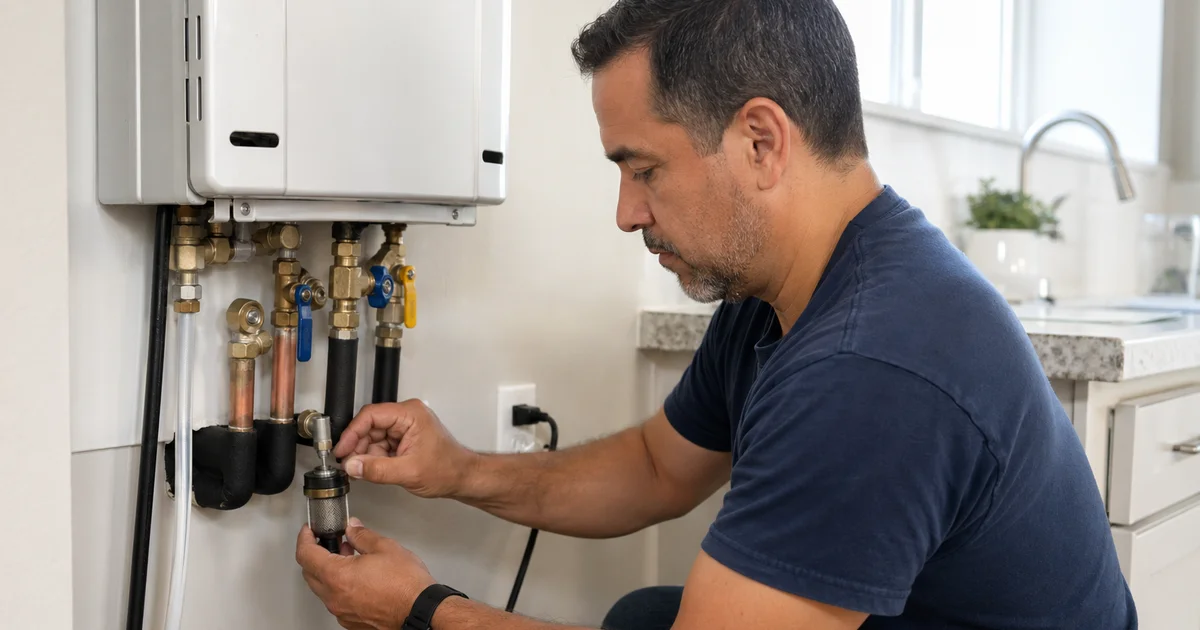
We understand the hesitation you feel before opening up a malfunctioning heating unit. When attempting a DIY tankless water heater repair, the dividing line between a safe five-minute tweak and a costly code violation is surprisingly thin. Our professional service team sees property owners across the US accidentally voiding 15-year warranties every single week.
Replacing a completely broken gas unit averages around $4,250 in 2026 based on recent market data. This financial reality makes proper maintenance choices absolutely critical. We will break down the exact components you can safely adjust today and clearly define when calling a licensed technician is your best option.
This guide shows you the exact steps to protect your investment.
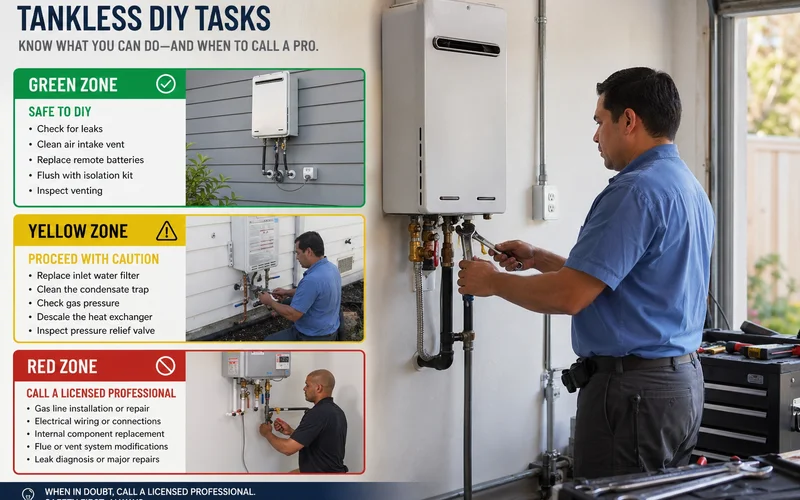
Safe DIY Tankless Water Heater Repair Tasks (Green Zone)
Basic maintenance routines are completely safe to handle on your own and will not risk your factory warranty. We encourage you to tackle simple tasks like cleaning the cold water inlet screen to prevent the most common no-flow issues.
You can save an average of $150 to $350 on routine service charges by performing these fundamental checks. Our technicians recommend keeping a basic toolkit nearby for these regular green-zone maintenance items.
Recommended Owner Tasks
- Inlet filter cleaning: This small mesh screen sits at the cold water inlet and catches debris. Remove it by hand, rinse it under warm tap water, and put it back to solve most low-flow symptoms instantly.
- Power-cycle reset: Turn off your main breaker for a full 30 seconds before flipping it back on. This quick action clears out transient system faults that do not point to a genuine mechanical failure.
- Air intake filter cleaning: Vacuum or rinse the exterior intake screen on your unit. Clearing out this dust dramatically improves combustion air supply and boosts efficiency.
- Visual inspection: Check the base for pooling water and inspect fittings for white scale buildup. Documenting these specific conditions gives your technician a huge head start if major problems arise later.
- System diagnostics: Check your user manual or our error codes guide to interpret the specific flashing numbers. Finding out exactly what the issue is before calling saves everyone valuable time.
Caution Zone (Possible But Not Recommended)
Replacing basic internal components like check valves is technically possible for handy homeowners, but tankless self repair at this level carries severe risks of voiding your coverage. We strongly advise against performing these advanced fixes unless you possess documented plumbing credentials.
A simple $80 to $150 pressure relief valve swap might look incredibly easy on a video tutorial. Our experts know that a leaking valve usually points to a dangerous upstream pressure spike that requires professional diagnostic tools to fix properly.
High-Risk Homeowner Fixes
- Inlet check valve replacement: Swapping this part is physically straightforward, but doing it without a certified installer license instantly voids most major manufacturer protections.
- Pressure relief valve replacement: Handling this component masks the root cause of the pressure issue. You could face a catastrophic tank failure later on if the pressure continues to build.
- External condensate line clearing: Clearing out clogs requires a deep understanding of proper slope angles and neutralizer placement. A botched job can send acidic condensation backing up directly into your heat exchanger.
If you decide to try any of these risky moves, photograph every single step of your work. Manufacturers will demand this visual proof if a related dispute comes up down the road.
Pro-Only Zone (Never DIY)
Any task involving the internal gas lines, combustion chambers, or complex computer control boards mandates a licensed plumber. We refuse to compromise on safety because a single mistake here can cause carbon monoxide leaks or catastrophic electrical fires.
Handling an advanced fix like a heat exchanger replacement runs between $600 and $1,300 in 2026, and attempting it yourself violates strict US building codes. Our team uses specialized equipment to handle these sensitive, brand-specific internal parts safely.
Tasks Requiring a Licensed Technician
- Gas line modifications: Touching the gas valve or regulator is an illegal code violation in nearly every US state. You risk a massive explosion, fire damage, and an immediate termination of your coverage.
- Combustion analysis: Testing fuel-air ratios demands a calibrated tool like the Bacharach Fyrite INSIGHT Plus, which costs upwards of $2,000. Guessing these numbers by looking at the flame is incredibly dangerous.
- Heat exchanger work: Working on the core heating element requires rigorous factory training to avoid destroying the expensive copper or stainless steel coils.
- Control board diagnostics: Troubleshooting the primary circuit board takes brand-specific software that manufacturers only distribute to certified dealers.
- Vent modification: Adjusting the exhaust vents is strictly regulated by local building codes and exact manufacturer specifications to prevent carbon monoxide poisoning.
Why DIY Voids Warranty
Major brands like Rinnai, Rheem, and Noritz include strict fine print stating that any service by a non-certified technician instantly nullifies your protection. We see property owners lose their 10 to 15-year heat exchanger coverage simply because they installed a generic, unauthorized replacement part.
Opening the cabinet to work on the gas, combustion, or sensitive internal sensors triggers this denial clause immediately. Our warranty specialists have watched manufacturers reject claims on completely unrelated components just because of a documented history of amateur tampering.
“Warranty is void if service is performed by anyone other than a factory-trained technician using OEM parts.”
Posting a picture of yourself fixing a control board on social media is the fastest way to lose thousands of dollars in future claims. The manufacturer will use that public proof to deny your request for a replacement unit.
Why Professional Service Is Worth It
Hiring a certified technician guarantees that your repair meets strict US safety codes while protecting your valuable equipment coverage. We highly recommend paying the average professional repair cost to avoid the massive $4,000 expense of replacing a completely ruined system.
A certified expert arrives with the correct original equipment manufacturer (OEM) parts and the training to do the job safely. Our service vans are fully stocked to save you the hassle of waiting days for a specific sensor to ship.
| Repair Approach | Average 2026 Cost | Warranty Status | Safety Risk Level |
|---|---|---|---|
| Amateur DIY Fix | $100 to $200 (Parts Only) | Instantly Voided | High (Gas/Fire Risk) |
| Licensed Pro Repair | $600 (Parts and Labor) | Fully Protected | Zero Risk |
The Professional Advantage
Skipping the amateur route and hiring a licensed specialist brings serious value to your property.
- Immediate OEM parts access: Technicians carry brand-specific parts on their trucks, which saves you from paying multiple trip charges.
- Calibrated safety testing: Professionals use expensive combustion analyzers to verify that dangerous gases are venting properly out of the building.
- Coverage preservation: Certified manufacturer training keeps your factory warranty completely valid.
- Code compliance: State licensing satisfies all local building codes and protects you from massive municipal fines.
- Bulletproof documentation: Proper service receipts provide the exact paperwork you need to support any future warranty claims.
You can access our tankless repair service to get a vetted local technician to your door, often on the exact same day.
Before you decide to fix tankless yourself, please read our DIY flushing risks guide to understand the hidden hazards.
Frequently Asked Questions
Can I clean my tankless water filter myself?
What happens if I work on the gas connection myself?
Are basic resets safe to attempt?
Related Guides
Cold Water Sandwich Problem in Tankless Water Heaters
What causes the 'cold water sandwich' tankless quirk — and why it's normal, not a defect. Recirculation pumps and mini-tank buffers that solve it.
Common Tankless Water Heater Problems and Signs You Need Repair
Mid-shower shutdowns, weird noises, low pressure, scaling — when each tankless symptom is a quick fix vs serious repair. Urgency level for each.
Tankless Water Heater Repair vs Replacement (Decision Guide)
When to fix vs replace a tankless: the 50% rule, age threshold, failure modes that always mean replacement. Honest decision framework with examples.
Tankless Water Heater Error Codes Explained (All Brands)
Common tankless error codes by brand: Rinnai 11/12, Navien E001/E003, Noritz, Rheem. What each code means, basic resets, and when to call a tech.