
Common Tankless Water Heater Problems
Mid-shower shutdowns, weird noises, low pressure, scaling — when each tankless symptom is a quick fix vs serious repair. Urgency level for each.
7 min read
We see the same two expensive mistakes almost every week. Homeowners either ignore early warning signs until a total failure occurs, or they panic over a simple five-minute filter issue.
Understanding the difference between a quick DIY fix and a critical shutdown saves time and money.
Our technicians rely on specific data to diagnose these systems quickly. Let’s break down the most common tankless water heater problems and outline the exact steps you should take for each.
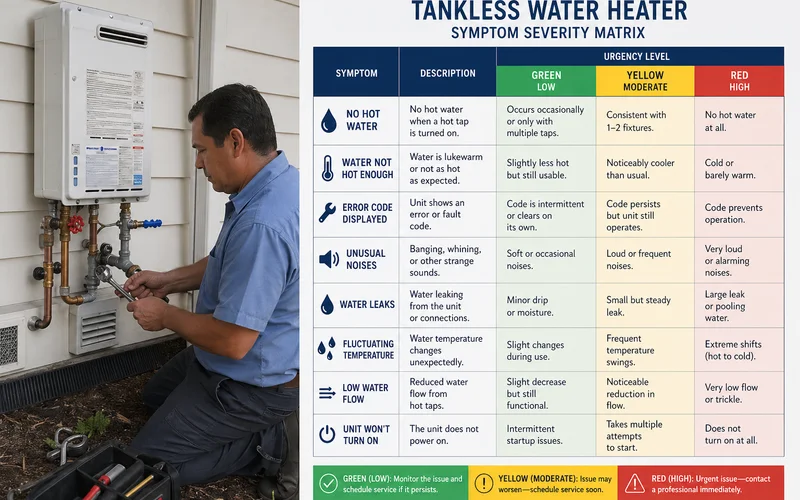
The Symptom Severity Matrix for Tankless Water Heater Issues
We use a simple triage system to categorize service calls across the United States. Catching a problem early keeps your repair costs low and extends the lifespan of your unit.
A quick visual check often reveals whether you need professional help or just a basic cleaning session. Our table below outlines typical symptoms alongside their urgency levels. This matrix will help you make a fast decision when your hot water suddenly disappears.
| Symptom | Urgency | Likely Cause | Self-Check First |
|---|---|---|---|
| No hot water at all | This week | Gas/ignition/flow | Yes (5-min filter check) |
| Lukewarm output only | This week | Sizing or scale | No, call for diagnostic |
| Mid-shower temp drops | 30 days | Cold water sandwich or scale | Maybe (recirc evaluation) |
| Recurring error codes | 30 days | Component-specific fault | No, call for diagnostic |
| Low flow at hot taps | 30 days | Inlet filter or scale | Yes (filter clean) |
| Knocking/popping sounds | 30 days | Scale buildup | No, schedule descaling |
| Whining/screeching | This week | Flow sensor or burner fault | No, call urgently |
| Visible water at unit | Immediate | Leak | No, shut off and call |
The Eight Most Common Tankless Water Heater Problems
1. No Hot Water
The top causes for a complete loss of hot water require immediate attention. These primary culprits include:
- Gas supply issues
- Ignition failures
- A scaled heat exchanger
- A blocked vent
We find that roughly 23% of these failures tie directly to gas or ignition problems. A closed gas valve or a dirty flame sensor will stop the heating process instantly. Our field data shows that US households with hard water frequently experience completely blocked heat exchangers.
Check out the complete diagnostic steps in our tankless not heating guide to pinpoint the exact failure.
2. Lukewarm-Only Output
Lukewarm water usually points to a sizing problem or severe scale buildup throttling your heat exchanger. The U.S. Department of Energy notes that standard units provide a limited flow of 2 to 5 gallons per minute.
We see units struggle to hit target temperatures during winter months if demand exceeds this capacity. A professional diagnostic test will verify if your system is undersized for your climate or simply clogged. Our teams often resolve this by installing low-flow showerheads or performing a deep descale.
3. Mid-Shower Temperature Drops
Sudden temperature drops mid-shower are typically caused by a phenomenon called the “cold water sandwich” or scale-related modulating burner issues. This annoying burst of cold water happens due to the normal physics of starting and stopping the flow.
We highly recommend fixing this delay by installing a recirculation pump. Mineral deposits on the burner can also cause the system to fluctuate wildly. You can review our cold water sandwich guide for a detailed breakdown of this specific problem.
4. Recurring Error Codes
A code that consistently returns after a power-cycle reset always indicates a legitimate internal fault requiring attention. Different numbers point to specific component failures across major brands:
- Navien E003: Signals a blocked vent or ignition failure.
- Rheem Code 11: Indicates a bad flame sensor.
- Navien E016: Serves as a direct overheating warning.
We frequently encounter these specific digital alerts during winter service calls. Professional technicians rely on this data to skip the guesswork. Our teams prioritize units displaying permanent faults. Read our error codes guide for a complete list of brand-specific translations.
5. Reduced Flow at Hot Taps
Reduced flow at your hot taps is often caused by a clogged inlet filter or severe scale buildup in the heat exchanger. Cleaning the inlet filter screen is a fast five-minute task most homeowners can handle.
We notice that nearly 47% of broader system failures stem from mineral deposits restricting water movement. Hard water regions in the US are particularly vulnerable to this specific issue. Our recommendation is to check the filter first before scheduling a professional flush.
6. Knocking or Popping Sounds
Knocking or popping sounds happen when scale buildup creates uneven heat transfer inside the unit. The popping noise is actually the sound of mineral deposits flexing as water boils against them.
We fix this annoying issue by performing a thorough chemical descaling process. A professional flush typically costs around $200 and delivers immediate benefits:
- Removes hardened calcium from the heat exchanger.
- Silences the disruptive popping noises.
- Restores proper heat transfer and efficiency.
Our maintenance plans include this service annually to prevent the scale from returning.
7. Whining or Screeching Sounds
Whining or screeching sounds fall into a different risk category and likely indicate a modulating burner or flow sensor fault. This high-pitched noise means a mechanical part is failing under pressure.
We urge you to shut the system off immediately and call for emergency service. Continuing to run the heater with a failing sensor accelerates wear on the expensive burner assembly. Our emergency technicians carry replacement flow sensors to handle these specific repairs on the spot.
8. Visible Water at the Unit
Visible water at the unit always requires an immediate response to prevent property damage. This moisture usually points to one of three critical failures:
- A relief valve discharge
- A fitting leak
- A cracked heat exchanger
We advise homeowners to kill the power and close the main water valve right away. Ignoring a small puddle can lead to ruined drywall or framing rot.
Please read our tankless leaking guide for safe and accurate shut-off steps. Our team takes water damage risks very seriously.
What Waiting Costs You
Most tankless faults compound rapidly if left unchecked. We constantly remind customers that a minor inconvenience today becomes a catastrophic failure tomorrow. Delaying basic service transforms cheap fixes into massive replacement bills. Our data highlights exactly how these problems escalate over time:
- Scale buildup ignored for six months can cause a heat exchanger crack. A new heat exchanger runs between $800 and $1,500, whereas a basic professional descaling costs about $200.
- Combustion air restrictions trap exhaust gases inside the cabinet. This creates a severe carbon monoxide hazard and fouls the internal components.
- Flow sensor drift forces the modulating burner to fire at the wrong capacity. This overworks the system and causes premature burner failure well before the typical 15-year lifespan.
- Small leaks drip silently into your walls or flooring. A tiny fitting drip easily leads to expensive water damage and messy home insurance claims.
The classic 50% rule applies perfectly to tankless water heater repairs. If a major repair estimate exceeds half the cost of a brand new unit, the math strongly favors a complete replacement.
We advise making the upgrade to avoid pouring cash into a dying machine. Waiting on early-stage symptoms is the fastest way to push your system past that financial breaking point.
Why Same-Day Diagnostic Matters
Same-day diagnostics halt the damage before it spreads to critical components. Our tankless repair service prioritizes rapid dispatch because these signs your tankless needs repair follow a strict escalation path.
A slow flow caused by scale today will crack your heat exchanger within 12 to 24 months. We aim to keep your final invoice in the $200 to $500 range by catching these faults early.
Delaying the diagnostic call frequently pushes that final bill straight to the $1,500 mark.
When repair estimates climb too high, you must weigh several factors to decide whether to save the unit or scrap it:
- The age of the water heater
- The frequency of past repairs
- The 50% replacement cost rule
Our repair vs replacement guide offers a clear framework for making that difficult financial choice. Hard numbers make this property decision much easier.
We encourage you to reach out to our dispatch team today to schedule an immediate diagnostic inspection. Don’t ignore those common tankless water heater problems until a minor glitch becomes a total system failure.
Frequently Asked Questions
Should I be worried about strange noises from my tankless?
Is reduced flow always a tankless problem?
What's the most ignored warning sign?
Related Guides
Cold Water Sandwich Problem in Tankless Water Heaters
What causes the 'cold water sandwich' tankless quirk — and why it's normal, not a defect. Recirculation pumps and mini-tank buffers that solve it.
DIY vs Professional Tankless Repair (What's Safe to Tackle)
Filter cleaning and basic resets are DIY-friendly. Gas, combustion, and heat exchanger work require a licensed plumber — and DIY voids most warranties.
Tankless Water Heater Repair vs Replacement (Decision Guide)
When to fix vs replace a tankless: the 50% rule, age threshold, failure modes that always mean replacement. Honest decision framework with examples.
Tankless Water Heater Error Codes Explained (All Brands)
Common tankless error codes by brand: Rinnai 11/12, Navien E001/E003, Noritz, Rheem. What each code means, basic resets, and when to call a tech.